Calculating Displacement from Velocity-Time Graphs quiz #1 Flashcards

Calculating Displacement from Velocity-Time Graphs quiz #1
Control buttons has been changed to "navigation" mode.
1/11
  • Which scenario best describes an object with a displacement of zero?
    An object has a displacement of zero if its final position is the same as its initial position, meaning it returns to where it started regardless of the path taken.
  • How do you determine the total displacement of an object after a given time interval using a velocity-time graph?
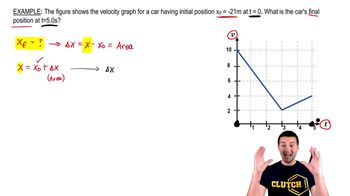
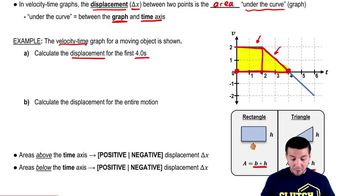
    To determine the total displacement after a given time interval using a velocity-time graph, calculate the area under the curve between the initial and final times. Sum the areas of all geometric shapes (rectangles, triangles) formed under the curve within that interval, considering areas above the time axis as positive and below as negative.
  • How do you find the net displacement of a particle between two times using a velocity-time graph?
    The net displacement of a particle between two times is found by calculating the total area under the velocity-time graph between those times, adding areas above the time axis (positive velocity) and subtracting areas below the time axis (negative velocity).
  • How do you determine the displacement of an object from a position-time graph?
    The displacement of an object from a position-time graph is the difference between its final position and its initial position.
  • If a car travels 20 km west and then 20 km south, what is the magnitude of its displacement vector?
    The magnitude of the displacement vector is found using the Pythagorean theorem: displacement = sqrt((20 km)^2 + (20 km)^2) = 20√2 km.
  • Why can two objects have the same displacement even if the distances they traveled are different?
    Two objects can have the same displacement if they start and end at the same positions, regardless of the different paths or distances traveled, because displacement depends only on the initial and final positions.
  • How do you calculate the displacement Δx of a particle using a velocity-time graph?
    To calculate the displacement Δx of a particle using a velocity-time graph, find the area under the curve between the initial and final times, summing the areas of all geometric shapes formed by the curve and the time axis.
  • How do you determine the overall displacement Δx of a particle from a velocity-time graph?
    The overall displacement Δx of a particle is determined by summing the areas under the velocity-time graph for each segment, treating areas above the time axis as positive and below as negative.
  • How do you express the overall displacement Δx of a particle in meters using a velocity-time graph?
    Express the overall displacement Δx in meters by calculating the total area under the velocity-time graph (using meters per second for velocity and seconds for time), ensuring the result is in meters.
  • How do you find the displacement Δx of a particle in meters from a velocity-time graph?
    Find the displacement Δx in meters by summing the areas under the velocity-time graph between the initial and final times, using the appropriate units for velocity and time.
  • What is the definition of displacement in terms of position?
    Displacement is defined as the difference between the final position and the initial position of an object.