Intro to Calorimetry definitions Flashcards

Intro to Calorimetry definitions
1 student found this helpful
Control buttons has been changed to "navigation" mode.
1/15
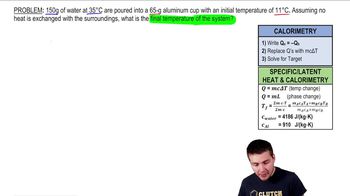
  • Calorimetry
    The study of measuring heat transfer during physical and chemical processes.
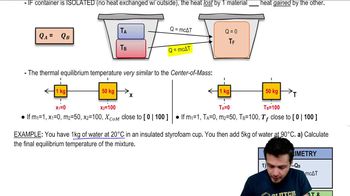
  • Thermal Equilibrium
    A state where two or more materials reach the same temperature and no heat flows between them.
  • Heat Transfer
    The movement of thermal energy from a hotter object to a cooler one.
  • Insulated Container
    A vessel that prevents heat exchange with the external environment.
  • Specific Heat
    The amount of heat required to change the temperature of a unit mass of a substance by one degree Celsius.
  • Mass
    The quantity of matter in an object, often measured in kilograms in calorimetry problems.
  • Temperature
    A measure of the average kinetic energy of particles in a substance, influencing heat transfer.
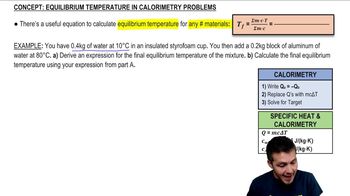
  • Equilibrium Temperature
    The final uniform temperature reached by materials in thermal equilibrium.
  • Heat Conservation
    The principle that total heat remains constant in an isolated system during heat transfer.
  • Delta T
    The change in temperature, calculated as final temperature minus initial temperature.
  • Algebra
    A branch of mathematics used to solve equations, crucial in deriving calorimetry formulas.
  • Center of Mass Analogy
    A comparison used to explain how equilibrium temperature skews towards the mass with higher heat.
  • Heat Equation
    An expression used to calculate heat transfer, often in the form Q = mcΔT.
  • Negative Sign
    Indicates the direction of heat flow, showing heat loss in calorimetry equations.
  • Plug and Chug
    A method of solving equations by substituting known values into a formula.