Pearson+ LogoPearson+ Logo

Intro to Calorimetry quiz #1 Flashcards

Intro to Calorimetry quiz #1
Control buttons has been changed to "navigation" mode.
1/10
  • What is calorimetry and how is it defined in the context of physics?

    Calorimetry is the study and measurement of heat transfer between materials at different temperatures, typically by mixing them in an insulated container until they reach thermal equilibrium. In calorimetry, the heat lost by the hotter material equals the heat gained by the colder one, and the process is analyzed using the principle of conservation of energy.
  • What does it mean for a calorimetry container to be thermally isolated?

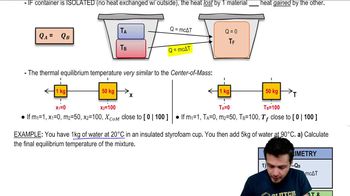
    A thermally isolated container does not exchange heat with its surroundings. This ensures that all heat transfer occurs only between the materials inside the container.
  • In calorimetry, what happens to the temperature of the colder material as heat is transferred?

    The temperature of the colder material increases as it gains heat. This process continues until thermal equilibrium is reached.
  • Why can the specific heat values be canceled out in some calorimetry problems?

    Specific heat values can be canceled out when all materials involved are the same substance. This simplifies the calculations since the specific heat is identical for each material.
  • How is the final equilibrium temperature affected if one material has a much larger mass than the other?

    The final equilibrium temperature will be closer to the initial temperature of the material with the larger mass. This is because the larger mass has a greater influence on the energy balance.
  • What is the algebraic process for isolating the final equilibrium temperature in a two-material calorimetry problem?

    You expand the temperature change terms, group all terms with the final temperature on one side, and then factor and solve for the final temperature. This involves distributing, combining like terms, and dividing by the sum of the mass-specific heat products.
  • How can the calorimetry equilibrium temperature equation be generalized for more than two materials?

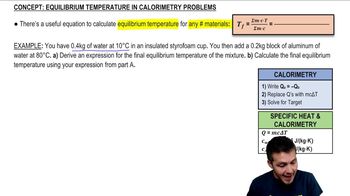
    The equation sums the products of mass, specific heat, and initial temperature for all materials in the numerator. The denominator is the sum of the products of mass and specific heat for all materials.
  • What analogy is used to help understand the concept of equilibrium temperature in calorimetry?

    The analogy of the center of mass is used, where the equilibrium temperature is skewed toward the material with greater mass and higher temperature. This helps visualize why the final temperature is not simply the average.
  • What is the significance of the negative sign in the equation QA = -QB?

    The negative sign indicates that the heat gained by one material is equal in magnitude but opposite in direction to the heat lost by the other. This reflects the conservation of energy within the system.
  • When expanding delta T in calorimetry equations, what is the correct form for each material?

    Delta T for each material is written as the final equilibrium temperature minus the initial temperature of that material. This ensures the direction of heat flow is correctly represented in the calculations.