Capacitance Using Calculus definitions Flashcards

Capacitance Using Calculus definitions
Control buttons has been changed to "navigation" mode.
1/15
  • Capacitance
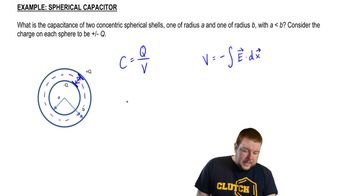
    The ability of a system to store charge per unit voltage, calculated as charge divided by potential difference.
  • Concentric Spherical Shells
    Two spherical surfaces sharing the same center but with different radii, one inside the other.
  • Electric Field
    A field around charged particles that exerts force on other charges, calculated as kq/r² for a point charge.
  • Gauss's Law
    A law stating that the electric flux through a closed surface is proportional to the charge enclosed.
  • Potential Difference
    The work needed to move a charge between two points in an electric field, calculated as V=-∫E·dr.
  • Radial Direction
    The direction pointing directly away from or towards the center of a sphere.
  • Integral
    A mathematical operation used to calculate areas under curves, here used to find potential difference.
  • Least Common Denominator
    The smallest common multiple of the denominators of two or more fractions.
  • Epsilon Naught
    The permittivity of free space, a constant used in calculating electric fields and capacitance.
  • Charge
    A property of matter that causes it to experience a force in an electric field, denoted as q.
  • Voltage
    The electric potential energy per unit charge, equivalent to potential difference.
  • K
    The Coulomb's constant, used in calculating electric forces and fields, equal to 1/4πε₀.
  • A constant factor appearing in formulas involving spheres, such as in the capacitance formula.
  • Radii
    The plural of radius, referring to the distances from the center to the surfaces of the spherical shells.
  • AB
    The product of the radii of the two concentric spherical shells, used in the capacitance formula.