Capacitors in AC Circuits definitions Flashcards

Capacitors in AC Circuits definitions
Control buttons has been changed to "navigation" mode.
1/15
  • Capacitor
    A device that stores electrical energy in an electric field, used in AC circuits to influence current and voltage.
  • AC Circuit
    An electrical circuit powered by alternating current, where the flow of electric charge periodically reverses direction.
  • Voltage
    The electric potential difference between two points, influencing the flow of current in a circuit.
  • Capacitance
    The ability of a capacitor to store charge per unit voltage, measured in farads.
  • Charge
    The amount of electric charge stored on a capacitor, influencing the voltage across it.
  • Current
    The flow of electric charge in a circuit, measured in amperes, and influenced by voltage and resistance.
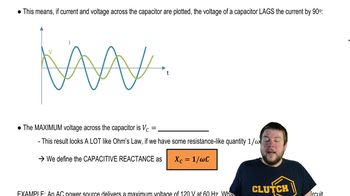
  • Capacitive Reactance
    A resistance-like quantity in AC circuits, inversely proportional to frequency and capacitance.
  • Omega
    The angular frequency in an AC circuit, calculated as 2π times the frequency.
  • Frequency
    The number of cycles per second in an AC circuit, measured in hertz.
  • Ohm's Law
    A principle stating that the current through a conductor is directly proportional to the voltage across it.
  • Resistance
    A measure of the opposition to current flow in an electrical circuit, measured in ohms.
  • Reactance
    The opposition to the change in current flow in an AC circuit, combining resistance and capacitive effects.
  • Phase Angle
    The angular difference between the voltage and current waveforms in an AC circuit.
  • Impedance
    The total opposition to current flow in an AC circuit, combining resistance and reactance.
  • Kirchhoff's Loop Rule
    A principle stating that the sum of the voltages around any closed loop in a circuit must equal zero.