Catch/Overtake Problems quiz #1 Flashcards

Catch/Overtake Problems quiz #1
Control buttons has been changed to "navigation" mode.
1/10
  • When a sailboat overtakes a powerboat, what does this mean in terms of their positions and times, and how can you determine when and where this occurs using motion equations?
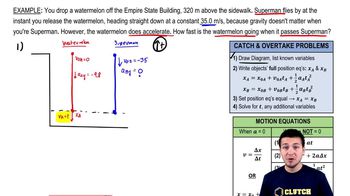
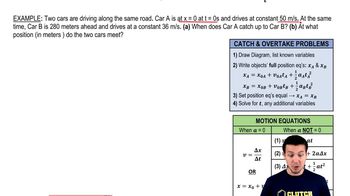
    When a sailboat overtakes a powerboat, it means both boats are at the same position at the same time. To determine when and where this occurs, write position equations for both boats using their initial positions and constant velocities. Set the two position equations equal to each other and solve for the time when their positions match. Then, substitute this time back into either position equation to find the position where the overtaking happens.
  • What does the slope of a line represent on a position-time graph in catch/overtake problems?
    The slope of a line on a position-time graph represents the velocity of the object. A steeper slope indicates a higher velocity.
  • Why can the acceleration term be omitted in the position equations for the cars in the example problem?
    The acceleration term can be omitted because both cars are moving at constant velocities, meaning their accelerations are zero. This simplifies the position equation to only include initial position and velocity terms.
  • How do you visually identify the overtaking point on a position-time graph?
    The overtaking point is where the lines representing the two objects' positions intersect on the graph. At this intersection, both objects have the same position at the same time.
  • What is the first step you should take when solving a catch/overtake problem?
    The first step is to draw a diagram and list all known variables for each object involved. This helps organize the information before setting up equations.
  • If two objects start at different positions but move at constant velocities, what must be true for one to overtake the other?
    The object behind must have a greater velocity than the object ahead. Otherwise, it will never catch up and overtake the other object.
  • How do you set up the equations to solve for the time when one object overtakes another?
    Write the position equations for both objects and set them equal to each other. Then solve the resulting equation for time.
  • After finding the time when two objects meet, how do you determine their meeting position?
    Substitute the calculated time back into either object's position equation. This will yield the position where both objects meet.
  • Why is it important to use the correct version of the position equation in these problems?
    Using the correct version ensures you account for initial position and velocity, which are crucial when objects start at different locations. This allows accurate calculation of when and where the overtaking occurs.
  • What does it mean if, after solving, both objects have the same position at the same time in your calculations?
    It means your solution is correct and the overtaking event has been properly identified. This confirms that the objects meet at that specific time and position.