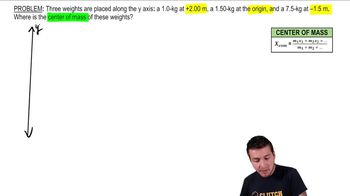
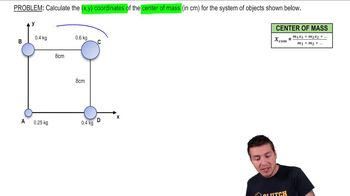
How do you calculate the x-coordinate (x_cm) of the center of mass for a system of objects located along a line, given their masses and positions?
The x-coordinate of the center of mass (x_cm) is calculated using the formula: x_cm = (m1*x1 + m2*x2 + ... + mn*xn) / (m1 + m2 + ... + mn), where mi and xi are the mass and position of each object.
Where is the center of mass and the center of gravity of a baseball located?
For a uniform baseball, the center of mass is at its geometric center. The center of gravity is also at the geometric center, since the gravitational field is uniform over the baseball.
Where is the center of mass of a hollow soccer ball?
The center of mass of a hollow soccer ball is at its geometric center, since the mass is distributed symmetrically around the center.
How do you determine the center of mass for a system consisting of two bodies with given masses and positions?
For two bodies with masses m1 and m2 at positions x1 and x2, the center of mass is at x_cm = (m1*x1 + m2*x2) / (m1 + m2).
Where is the center of mass of the Earth–Moon system located relative to the two bodies?
The center of mass of the Earth–Moon system is located along the line connecting their centers, closer to the more massive Earth. Its position can be found using x_cm = (m_Earth*x_Earth + m_Moon*x_Moon) / (m_Earth + m_Moon), where x_Earth and x_Moon are the positions of Earth and Moon, respectively.
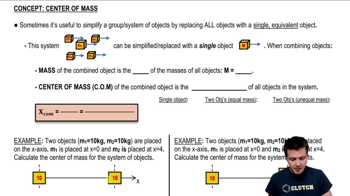
What happens to the total mass when you combine multiple objects into a single equivalent object for center of mass calculations?
The total mass becomes the sum of all the individual masses in the system. This combined mass is used to represent the system as a single object.
Where is the center of mass located for two objects of equal mass placed at different positions on a number line?
The center of mass is exactly halfway between the two objects. This is because their masses are equal, so the average position is the midpoint.
How does the center of mass shift when one object in a two-object system is heavier than the other?
The center of mass moves closer to the heavier object. This is because the heavier mass has a greater influence on the average position.
If you have a single object, where is its center of mass located?
The center of mass of a single object is at its own geometric center. This is true regardless of the object's position.
What is the purpose of replacing a system of objects with a single equivalent object at the center of mass in physics problems?
It simplifies calculations by reducing the system to one object with the same total mass at the center of mass position. This makes analyzing motion and forces much easier.