Back

Centripetal Forces quiz #1

Control buttons has been changed to "navigation" mode.
1/21
  • What is a characteristic of centripetal acceleration in circular motion?

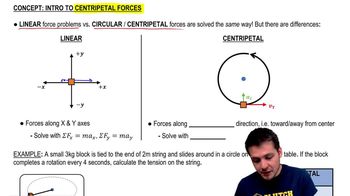
    Centripetal acceleration always points toward the center of the circle along which the object moves.
  • In which direction does the centripetal force act on an object in circular motion?

    The centripetal force acts toward the center of the circle.
  • Which expression can be used to calculate centripetal acceleration for an object moving in a circle?

    Centripetal acceleration can be calculated using the formula a_c = v^2 / r, where v is the speed and r is the radius of the circle.
  • How is centripetal acceleration defined for an object in uniform circular motion?

    Centripetal acceleration is the acceleration directed toward the center of the circle, given by a_c = v^2 / r.
  • What provides the centripetal force exerted on a satellite in orbit around a planet?

    The gravitational force between the satellite and the planet provides the centripetal force.
  • Which force is not an example of a centripetal force?

    A force acting tangentially to the motion is not a centripetal force, since centripetal forces always point toward the center.
  • At what point during circular motion do riders experience centripetal acceleration?

    Riders experience centripetal acceleration at every point along the circular path, always directed toward the center.
  • How is the desired centripetal force set for an object in circular motion?

    The desired centripetal force is set by adjusting the net force acting toward the center, which can be achieved by changing variables such as mass, speed, or radius according to F_c = m v^2 / r.
  • Does the centripetal force acting on an object in uniform circular motion do work on the object?

    No, the centripetal force does not do work because it acts perpendicular to the direction of motion.
  • What force acts as the centripetal force that allows a car to move around a sharp curve in a roadway?

    The frictional force between the car's tires and the road acts as the centripetal force.
  • In which sport does centripetal force play a key role in the motion of participants or equipment?

    Centripetal force plays a key role in sports such as car racing, where vehicles move along curved tracks.
  • Which force is considered to be 'center seeking' in circular motion?

    The centripetal force is considered to be 'center seeking' because it always points toward the center of the circle.
  • What force acts as the centripetal force to keep a car moving through a curve?

    The frictional force between the tires and the road acts as the centripetal force.
  • How does a centripetal force cause circular motion?

    A centripetal force causes circular motion by continuously accelerating the object toward the center, changing the direction of its velocity.
  • What measurements are needed to determine the magnitude of the centripetal acceleration of a test mass in circular motion?

    To determine centripetal acceleration, you need to measure the speed of the object and the radius of the circular path.
  • Which formula can be used to find the centripetal acceleration of an orbiting object?

    The formula a_c = v^2 / r can be used to find the centripetal acceleration of an orbiting object.
  • How does the concept of centripetal force apply to circular motion in physics?

    Centripetal force is the net force directed toward the center of a circle that keeps an object moving in circular motion, and is calculated using F_c = m v^2 / r.
  • Why does a centripetal force cause circular motion?

    A centripetal force causes circular motion because it provides the necessary inward acceleration to continually change the direction of the object's velocity, keeping it moving along a circular path.
  • In physics, what is a centripetal force and how does it relate to circular motion?

    A centripetal force is the net force that acts on an object moving in a circular path, always directed toward the center of the circle. It is responsible for causing the centripetal acceleration required for circular motion and is calculated using Newton's second law as F = m*v^2/r, where m is mass, v is velocity, and r is the radius of the circle.
  • How do you calculate the tension in a string holding a mass moving in a horizontal circle?

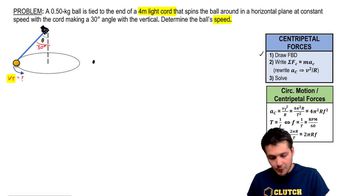
    The tension in the string provides the centripetal force needed for circular motion and is calculated using the formula T = m*v^2/r, where m is the mass, v is the velocity (which can be found using v = 2πr/T, with T as the period), and r is the radius of the circle.
  • Which force acting perpendicular to motion is not a centripetal force?

    A normal force acting perpendicular to the motion (not directed toward the center of the circle) is NOT an example of a centripetal force. Centripetal forces must act toward the center of the circular path, such as tension, gravity, or friction when they provide the necessary inward force.