Pearson+ LogoPearson+ Logo

Charging By Induction quiz #1 Flashcards

Charging By Induction quiz #1
Control buttons has been changed to "navigation" mode.
1/10
  • What is an example of gaining a static charge by conduction?

    Gaining a static charge by conduction occurs when a charged object physically touches a neutral object, allowing electrons to transfer between them and leaving the neutral object with a net charge.
  • What happens when a neutral object is charged by induction using a nearby charged object?

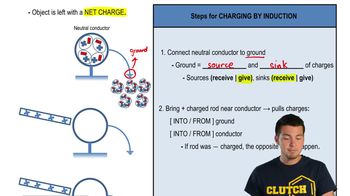
    When a neutral object is charged by induction, a charged object is brought near it (without touching), causing polarization. The neutral object is connected to the ground, allowing electrons to flow in or out depending on the charge of the nearby object. After disconnecting the ground and removing the charged object, the neutral object is left with a net charge.
  • What is the difference between charging by contact and charging by induction?

    Charging by contact (conduction) requires direct physical contact between objects, allowing electrons to transfer. Charging by induction does not require contact; instead, a charged object is brought near a neutral object, and grounding allows electrons to move, resulting in a net charge after the ground is disconnected and the charged object is removed.
  • What is the difference between charging by conduction and charging by induction?

    Charging by conduction involves direct contact between objects, transferring electrons and leaving a net charge. Charging by induction uses a nearby charged object and grounding to redistribute charges in a neutral object without direct contact, resulting in a net charge after disconnecting the ground and removing the charged object.
  • What is the role of the ground in the process of charging by induction?

    The ground acts as a massive reservoir that can supply or absorb electrons during induction. It allows charges to move into or out of the conductor depending on the nearby charged object's polarity.
  • What happens to the distribution of charges inside a neutral conductor when a charged rod is brought near it during induction?

    The charges inside the neutral conductor become polarized, with opposite charges accumulating near the rod and like charges moving away. This polarization occurs even before any electrons move to or from the ground.
  • Why is it important to disconnect the conductor from the ground before removing the charged rod in induction?

    Disconnecting the ground first prevents the accumulated charges from escaping back to the earth. This step ensures the conductor retains its net charge after the rod is removed.
  • How does the process differ if a negatively charged rod is used instead of a positively charged rod in induction?

    If a negatively charged rod is used, electrons are repelled from the conductor into the ground, leaving the conductor positively charged. The direction of electron flow is opposite compared to using a positively charged rod.
  • What is the final result for the conductor after completing all steps of charging by induction?

    The conductor is left with a net charge, having an imbalance of positive and negative charges. This occurs without any direct contact with the charged rod.
  • What does the ground symbol with three bars represent in induction diagrams?

    The ground symbol with three bars represents a connection to the earth, which serves as a source or sink for electric charges. It indicates the conductor can exchange electrons freely with the ground during the induction process.