Charging Objects definitions Flashcards

Charging Objects definitions
Control buttons has been changed to "navigation" mode.
1/15
  • Electricity
    The movement of electrons or electric charges, primarily within conductors.
  • Conductors
    Materials that allow electrons and electric charges to move freely, like metals.
  • Insulators
    Materials that restrict electron movement, such as plastics and rubber.
  • Electrons
    Subatomic particles that move within conductors, enabling electricity.
  • Protons
    Subatomic particles with a positive charge that do not move in conductors.
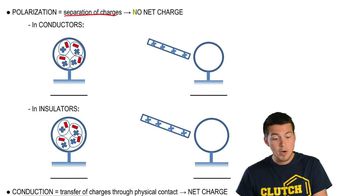
  • Polarization
    Separation of charges in an object, resulting in no net charge.
  • Conduction
    Transfer of charges through direct contact, occurring only in conductors.
  • Net Charge
    The overall charge of an object after conduction, can be positive or negative.
  • Positive Charge
    Charge type that attracts electrons and repels other positive charges.
  • Negative Charge
    Charge type that attracts protons and repels other negative charges.
  • Charge Transfer
    Movement of electric charge from one object to another, often by rubbing.
  • Electric Charge
    Property of matter that causes it to experience a force in an electric field.
  • Neutral Conductor
    A conductor with equal numbers of positive and negative charges.
  • Glass Rod
    An object used in experiments to demonstrate charge transfer and polarization.
  • Opposites Attract
    Principle stating that unlike charges attract each other.