Charging Objects quiz #1 Flashcards

Charging Objects quiz #1
Control buttons has been changed to "navigation" mode.
1/10
  • Why does a glass rod become positively charged when it is rubbed with a silk cloth?
    When a glass rod is rubbed with a silk cloth, electrons are transferred from the glass rod to the silk. This loss of electrons leaves the glass rod with an excess of positive charge, making it positively charged.
  • What does it mean for an object to become charged?
    An object becomes charged when it gains or loses electrons, resulting in a net electric charge. If it gains electrons, it becomes negatively charged; if it loses electrons, it becomes positively charged.
  • Which process can result in an object becoming electrostatically charged?
    Rubbing two objects together can result in one or both objects becoming electrostatically charged by transferring electrons from one object to the other.
  • What type of charging occurs when you slide your body across a plastic surface?
    Sliding your body across a plastic surface causes charging by friction, which transfers electrons between your body and the plastic, resulting in electrostatic charge.
  • What is the primary particle that moves to create electricity in materials?
    The primary particle that moves to create electricity is the electron. Protons do not move in this process.
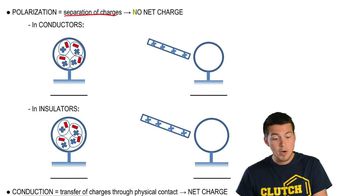
  • How does polarization in a conductor differ from polarization in an insulator?
    In a conductor, electrons move freely to create regions of positive and negative charge, while in an insulator, charges within atoms rearrange without free electron movement. Both processes result in polarization but by different mechanisms.
  • What happens to the distribution of electrons in a neutral conductor when a positively charged rod is brought near it?
    Electrons in the conductor are attracted toward the side closest to the positively charged rod, creating a region of negative charge there. The opposite side becomes relatively positive, but the conductor remains overall neutral.
  • Why does conduction only occur in conductors and not in insulators?
    Conduction requires the movement of electrons, which is only possible in conductors where electrons can move freely. In insulators, electrons are not free to move, so conduction cannot occur.
  • What is the result of conduction when a charged rod touches a neutral conductor and is then removed?
    The neutral conductor is left with a net electric charge after the charged rod is removed. This is because electrons have been transferred during contact, resulting in an imbalance of charge.
  • How would the polarization process change if a negatively charged rod is used instead of a positively charged rod?
    If a negatively charged rod is used, the arrangement of positive and negative charges in both conductors and insulators would be reversed compared to using a positively charged rod. The side closest to the rod would become more positive instead of negative.