Combining Capacitors in Series & Parallel definitions Flashcards

Combining Capacitors in Series & Parallel definitions
Control buttons has been changed to "navigation" mode.
1/15
  • Capacitor
    A device that stores electrical energy in an electric field, used in various electronic circuits.
  • Equivalent Capacitance
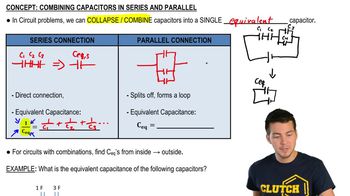
    The total capacitance of a circuit that behaves as a single capacitor with the same effect as the combined capacitors.
  • Series Connection
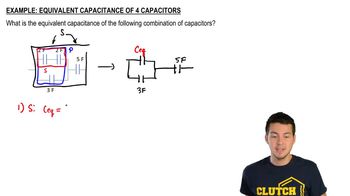
    An arrangement where capacitors are connected end-to-end, and the total capacitance is found using the inverse sum of reciprocals.
  • Parallel Connection
    An arrangement where capacitors are connected across the same two points, and the total capacitance is the sum of individual capacitances.
  • Reciprocal
    The inverse of a number; for capacitance, used in calculating equivalent capacitance in series.
  • Farad
    The unit of capacitance, defined as one coulomb per volt.
  • Inverse Sum
    A method to calculate equivalent capacitance in series by summing the reciprocals of individual capacitances.
  • Junction
    A point in a circuit where a wire splits into multiple paths, often used in parallel connections.
  • Loop
    A closed path in a circuit, often formed in parallel connections where current can flow.
  • Shortcut
    A simplified method for calculating equivalent capacitance in series for two capacitors by multiplying and dividing by their sum.
  • Denominator
    The bottom number in a fraction, important in calculations involving reciprocals and fractions.
  • Fraction
    A numerical quantity that is not a whole number, used in calculations of equivalent capacitance.
  • Battery
    A device that provides a voltage source for circuits, often used to charge capacitors.
  • Circuit
    A closed path through which electric current flows, often containing capacitors in series or parallel.
  • Calculation
    The process of determining equivalent capacitance using mathematical operations on capacitance values.