How do you determine the equivalent capacitance of a circuit that contains a combination of capacitors connected in both series and parallel?
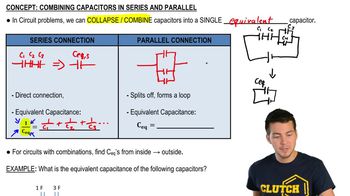
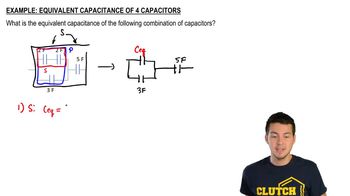
To find the equivalent capacitance of a circuit with both series and parallel capacitor combinations, first identify and simplify the innermost groups of capacitors using the appropriate rules: for capacitors in series, use 1/CEQ = 1/C1 + 1/C2 + ... and then take the reciprocal; for capacitors in parallel, use CEQ = C1 + C2 + .... Work step by step from the innermost connections outward, simplifying the circuit until only one equivalent capacitance remains.
What does the term 'equivalent capacitance' mean in the context of capacitor circuits?
Equivalent capacitance is the single capacitance value that would behave the same as the entire combination of capacitors in a circuit. It allows you to replace a complex arrangement with one capacitor for analysis.
How are capacitors arranged in a series connection within a circuit?
In a series connection, capacitors are connected end-to-end so that the same charge passes through each one sequentially. This means the output of one capacitor is directly connected to the input of the next.
What is a common mistake students make when calculating equivalent capacitance for capacitors in series?
A common mistake is forgetting to take the reciprocal of the sum of the reciprocals after adding them. This leads to an incorrect value for the equivalent capacitance.
How do you identify a parallel connection of capacitors in a circuit diagram?
A parallel connection is identified when wires split at a junction and capacitors branch off into their own loops, not following directly one after another. Each capacitor in parallel shares the same voltage across it.
What shortcut can be used to find the equivalent capacitance of two capacitors in series?
For two capacitors in series, multiply their capacitances and divide by their sum to get the equivalent capacitance. This shortcut only works for exactly two capacitors in series.
When simplifying a complex circuit with both series and parallel capacitors, what is the recommended approach?
Start by identifying and simplifying the innermost groups of capacitors, working from the inside out. This means handling the smallest series or parallel groups first before moving outward.
How do you add the capacitances of capacitors that are in parallel?
Simply add the capacitance values together for all capacitors in parallel. The total equivalent capacitance is the sum of the individual capacitances.
What is the equivalent capacitance of two capacitors with values 1 F and 3 F connected in series?
The equivalent capacitance is 3/4 F. This is found by using the series formula or the shortcut for two capacitors.
If you have two groups of capacitors, each group in parallel, and then those groups are connected in series, how do you find the total equivalent capacitance?
First, add the capacitances within each parallel group, then use the series formula to combine the two resulting values. This stepwise approach ensures correct calculation of the total equivalent capacitance.