What is the most likely explanation for a change in the slope of a position-time graph?
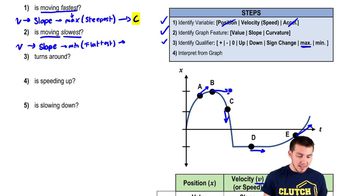
A change in the slope of a position-time graph indicates a change in velocity. A steeper slope means a higher velocity, while a flatter slope indicates a lower velocity.
What does the slope of a position-time graph represent?
The slope of a position-time graph represents velocity.
What does the slope of a position-time graph represent in motion graphs?
The slope of a position-time graph represents the velocity of the object.
What does curvature in a position-time graph represent?
Curvature in a position-time graph represents acceleration.
What do the slope and curvature of a position-time graph represent?
The slope represents velocity and the curvature represents acceleration.
What type of problems are typically not solved using position-time graphs?
Problems that require direct calculation of force are not typically solved using position-time graphs.
What does the slope of a position-time graph at any point give?
The slope of the graph at any point gives the instantaneous velocity of the object.
Which is a true statement about the relationship between position and time in motion graphs?
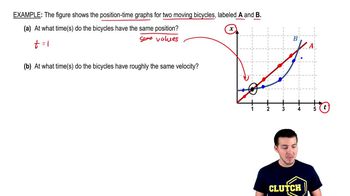
A true statement is that the position of an object at any given time can be determined by the value on the y-axis of a position-time graph.
What is meant by the statement that two variables are related in the context of motion graphs?
In motion graphs, two variables are related if changes in one variable (e.g., time) affect the other variable (e.g., position), as shown by the graph's slope or curvature.
Which is the toughest concept to grasp when interpreting position-time graphs?
The toughest concept is often understanding how curvature relates to acceleration, as it requires recognizing the graph's concavity.
Which of these is not correct regarding the interpretation of motion graphs?
It is not correct to say that a downward slope on a position-time graph indicates positive acceleration; it actually indicates negative velocity.
What does a flat slope indicate in the context of motion graphs?
A flat slope indicates zero velocity, not acceleration.
 Back
Back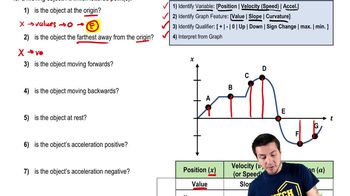
 09:48
09:48