Conservation of Energy in Rolling Motion definitions Flashcards
Conservation of Energy in Rolling Motion definitions
You can tap to flip the card.
Control buttons has been changed to "navigation" mode.
1/15
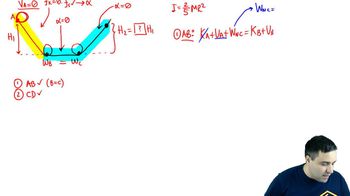
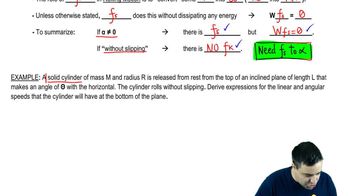
Rolling MotionA type of motion where an object rotates around its axis while also translating along a surface.Static FrictionThe force that enables rolling motion by converting linear velocity into angular velocity without energy loss.Angular VelocityThe rate of rotation of an object, often denoted as omega, related to linear velocity in rolling motion.Moment of InertiaA measure of an object's resistance to changes in its rotation, crucial for calculating rotational kinetic energy.Rotational Kinetic EnergyThe energy due to an object's rotation, calculated using its moment of inertia and angular velocity.Translational Kinetic EnergyThe energy due to an object's linear motion, calculated using its mass and velocity.Conservation of EnergyA principle stating that total energy remains constant in a closed system, applied to both kinetic and potential energies.Potential EnergyThe energy stored due to an object's position, often related to height in gravitational fields.Solid CylinderA geometric shape with a specific moment of inertia, used in rolling motion problems.Inclined PlaneA flat surface tilted at an angle, used to study motion and energy conversion in physics.Linear VelocityThe rate of change of position of an object, related to angular velocity in rolling motion.RadiusThe distance from the center to the edge of a circular object, crucial in calculating angular velocity.CoefficientA numerical factor in equations, indicating the distribution of energy in rolling motion.HeightThe vertical distance an object is above a reference point, affecting its potential energy.AccelerationThe rate of change of velocity, requiring static friction in rolling motion to occur.