Intro to Acceleration quiz #4 Flashcards
BackIntro to Acceleration quiz #4
You can tap to flip the card.
Control buttons has been changed to "navigation" mode.
1/31
What does acceleration measure?
Acceleration measures how quickly an object's velocity changes over time.What is the formula for acceleration?
Acceleration is calculated as a = Δv / Δt, where Δv is the change in velocity and Δt is the change in time.What are the SI units for acceleration?
The SI unit for acceleration is meters per second squared (m/s²).Is acceleration a vector or a scalar quantity?
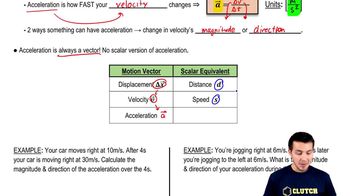
Acceleration is always a vector quantity, meaning it has both magnitude and direction.What causes a change in velocity?
A change in velocity can be caused by a change in the magnitude or direction of the velocity.If an object's velocity is constant, what is its acceleration?
If velocity is constant, acceleration is zero.What is the difference between velocity and acceleration?
Velocity measures how fast position changes, while acceleration measures how fast velocity changes.What can be measured by acceleration?
Acceleration measures the rate at which an object's velocity changes.What occurs when an object's velocity decreases?
When an object's velocity decreases, it experiences negative acceleration (also called deceleration).How is acceleration expressed in terms of units?
Acceleration is expressed in units of meters per second squared (m/s²).Acceleration depends on which two factors?
Acceleration depends on the change in velocity and the time interval over which the change occurs.How do you find the magnitude of acceleration?
The magnitude of acceleration is found using the formula |a| = |Δv| / |Δt|.How do you find the magnitude of average acceleration?
Average acceleration is calculated as a_avg = (v_final - v_initial) / (t_final - t_initial).How can you find acceleration from distance and time if velocity is not given?
If initial velocity is zero, acceleration can be found using kinematic equations, such as a = 2d / t², where d is distance and t is time.How do you find the magnitude of acceleration given velocity and time?
Acceleration is found using a = (v_final - v_initial) / Δt.What is the acceleration lane on freeways used for?
The acceleration lane on freeways is used for vehicles to increase their velocity to match the speed of traffic.What is the rate at which velocity changes over time?
The rate at which velocity changes over time is acceleration.What is the SI unit for measuring acceleration?
The SI unit for measuring acceleration is meters per second squared (m/s²).What is the unit for acceleration?
The unit for acceleration is meters per second squared (m/s²).What are the units of acceleration?
The units of acceleration are meters per second squared (m/s²).What is the rate velocity changes with time?
The rate at which velocity changes with time is called acceleration.What is the difference between acceleration and velocity?
Acceleration is the rate of change of velocity, while velocity is the rate of change of position.What does acceleration measure in terms of motion?
Acceleration measures how quickly and in what direction an object's velocity changes.What happens to acceleration if velocity does not change?
If velocity does not change, acceleration is zero.Is there a scalar equivalent for acceleration?
No, acceleration does not have a scalar equivalent; it is always a vector.Can acceleration result from a change in direction?
Yes, acceleration can result from a change in the direction of velocity, even if the speed remains constant.How is acceleration related to velocity?
Acceleration is the rate at which velocity changes over time.What is the general formula for acceleration?
The general formula for acceleration is a = Δv / Δt.What does a negative acceleration indicate?
Negative acceleration indicates that the object is slowing down or accelerating in the opposite direction.What is required for an object to accelerate?
An object accelerates if its velocity changes in magnitude or direction.What is the vector nature of acceleration?
Acceleration is a vector, meaning it has both magnitude and direction.