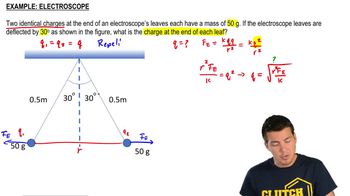
According to Coulomb's Law, what is the formula for the electric force between two point charges?
The electric force between two point charges is given by Coulomb's Law: F = k * (Q1 * Q2) / r^2, where F is the force, k is Coulomb's constant (8.99 x 10^9 Nm^2/C^2), Q1 and Q2 are the charges, and r is the distance between them.
If the distance between two point charges is doubled, how does the electric force between them change according to Coulomb's Law?
If the distance between two charges doubles, the electric force between them becomes one-fourth as strong, since the force is inversely proportional to the square of the distance (F ∝ 1/r^2).
How does the magnitude of the electric force between two charged particles depend on their charges and the distance between them?
The magnitude of the electric force between two charged particles is directly proportional to the product of their charges and inversely proportional to the square of the distance between them, as described by F = k * (Q1 * Q2) / r^2.
How does the electric force between two charged objects change as the distance between them increases?
As the distance between two charged objects increases, the electric force between them decreases rapidly, specifically with the square of the distance (F ∝ 1/r^2).
What is the general method to calculate the magnitude of the electric force on a charge due to another charge using Coulomb's Law?
To calculate the magnitude of the electric force on a charge due to another charge, use the formula F = k * (Q1 * Q2) / r^2, where Q1 and Q2 are the charges and r is the distance between them. Plug in the values for the charges and distance, and use positive numbers for magnitude.
State the law of electrostatic force and explain whether the force is attractive or repulsive.
The law of electrostatic force (Coulomb's Law) states that the force between two point charges is F = k * (Q1 * Q2) / r^2. The force is attractive if the charges are unlike (one positive, one negative) and repulsive if the charges are alike (both positive or both negative).
What is the value and SI units of Coulomb's constant k used in Coulomb's Law?
Coulomb's constant k is 8.99 x 10^9 N·m^2/C^2. The units are Newton meter squared per Coulomb squared.
When calculating the magnitude of the electric force using Coulomb's Law, should you use the sign of the charges or just their absolute values?
You should use the absolute values (positive numbers) of the charges when calculating the magnitude. The direction (attractive or repulsive) is determined separately based on the types of charges.
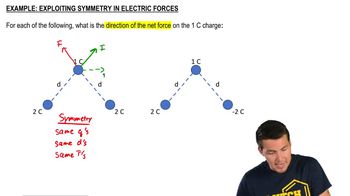
In the example with two identical charges connected by a wire, what physical quantity is set equal to the electric force to solve for the charge magnitude?
The tension in the wire is set equal to the electric force. This is because the system is in equilibrium, so the repulsive electric force is balanced by the tension.
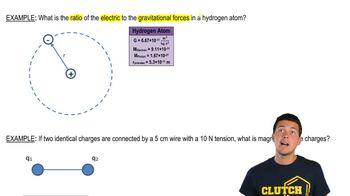
How does the electric force between a proton and an electron in a hydrogen atom compare to the gravitational force between them?
The electric force is vastly stronger than the gravitational force between a proton and an electron. Specifically, it is about 2.27 x 10^39 times greater.