What is an everyday example of a diffraction grating?
An everyday example of a diffraction grating is a compact disc (CD) or DVD, where the closely spaced tracks act as a series of slits that diffract light and produce colorful patterns.
What happens to light as a result of diffraction when it passes through a narrow slit?
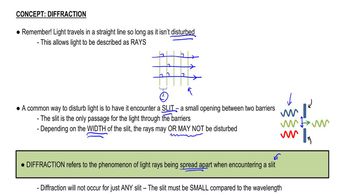
As a result of diffraction, light spreads out in different directions after passing through a narrow slit, creating a pattern of alternating bright and dark spots known as a diffraction pattern.
What principle is responsible for light spreading as it passes through a narrow slit?
The principle responsible for light spreading as it passes through a narrow slit is diffraction, which occurs when the slit width is small compared to the wavelength of light.
How can diffraction be described in terms of light behavior?
Diffraction can be described as the phenomenon where light rays spread apart after passing through a slit whose width is small compared to the wavelength of the light.
How does the diffraction of light occur according to the provided materials?
Diffraction of light occurs when light passes through a slit with a width smaller than its wavelength, causing the light to spread out isotropically (in all directions) and form a diffraction pattern.
What condition will cause diffraction of light?
Diffraction of light will occur when the width of the slit is small compared to the wavelength of the light.
How does the phenomenon of diffraction affect the direction of light rays after passing through a narrow slit?
After passing through a narrow slit, diffraction causes the light rays to spread out in different directions rather than remaining parallel.
How does diffraction affect the propagation of a wireless signal?
Diffraction allows a wireless signal to bend around obstacles and spread out after passing through small openings, enabling the signal to reach areas that are not in a direct line of sight.
What causes the fuzzy glow around a full moon observed from Earth?
The fuzzy glow around a full moon is caused by diffraction of moonlight as it passes through small particles or droplets in Earth's atmosphere.
If a commercial diffraction grating has 300 lines per millimeter, how can you calculate the distance between adjacent lines?
The distance between adjacent lines (d) can be calculated as the reciprocal of the number of lines per millimeter: d = 1 / (300 lines/mm) = 1/300 mm per line.
How do you determine the spacing between lines on a diffraction grating with 2000 lines per centimeter?
The spacing between lines (d) is the reciprocal of the number of lines per centimeter: d = 1 / (2000 lines/cm) = 0.0005 cm per line, or 5 × 10⁻⁶ meters per line.
What are the two main factors that affect the diffraction of a wave when it passes through a slit?
The two main factors that affect the diffraction of a wave are the wavelength of the wave and the width of the slit. Diffraction is most pronounced when the slit width is small compared to the wavelength.
 Back
Back

 08:44
08:44