Dipole Moment quiz #1 Flashcards

Dipole Moment quiz #1
Control buttons has been changed to "navigation" mode.
1/10
  • What is an electric dipole?
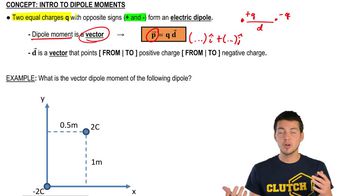
    An electric dipole consists of two equal and opposite charges separated by a distance. It is characterized by a dipole moment, which is a vector pointing from the positive charge to the negative charge.
  • How is the dipole moment of an electric dipole consisting of charges of magnitude Q separated by a distance d defined?
    The dipole moment P of an electric dipole is defined by the vector equation P = Q * d, where Q is the magnitude of each charge and d is the vector pointing from the positive to the negative charge.
  • In which direction does the dipole moment vector point for an electric dipole?
    The dipole moment vector points from the positive charge to the negative charge. This direction is consistent with the convention used for electric field lines.
  • How do you represent the dipole moment vector in component form?
    The dipole moment vector is represented using its components in the i (x) and j (y) directions. You multiply the charge magnitude by each component of the distance vector to get the full vector form.
  • What is the significance of the angle theta in the potential energy formula for a dipole in an electric field?
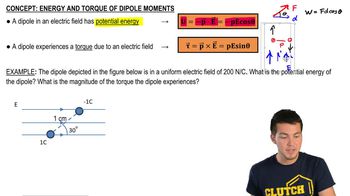
    Theta is the angle between the dipole moment vector and the electric field vector. It determines the value of the cosine term in the potential energy formula.
  • Why does an electric dipole experience torque in a uniform electric field?
    An electric dipole experiences torque because the electric field exerts forces on the positive and negative charges in opposite directions, causing a rotational effect. This torque tends to align the dipole moment with the electric field.
  • What must you be careful about when determining the angle between the dipole moment and the electric field?
    You must ensure you are measuring the angle from the dipole moment vector to the electric field vector, considering their directions. If the vectors are reversed, the angle may be negative or different from what is shown in a diagram.
  • How do you calculate the magnitude of the dipole moment if given charges in coulombs and distance in meters?
    Multiply the magnitude of one of the charges by the distance separating them in meters. The result gives the dipole moment in coulomb-meters (C·m).
  • What happens to the potential energy of a dipole as it aligns with the electric field?
    The potential energy becomes more negative as the dipole aligns with the electric field. This indicates a more stable configuration for the dipole.
  • What is the formula for the magnitude of torque on a dipole in a uniform electric field?
    The magnitude of the torque is given by P * E * sin(theta), where P is the dipole moment, E is the electric field strength, and theta is the angle between them. This formula describes the rotational effect on the dipole.