Skip to main content
Physics with Calculus
My Course
Learn
Exam Prep
AI Tutor
Study Guides
Textbook Solutions
Flashcards
Explore
Try the app
My Course
Learn
Exam Prep
AI Tutor
Study Guides
Textbook Solutions
Flashcards
Explore
Try the app
Back
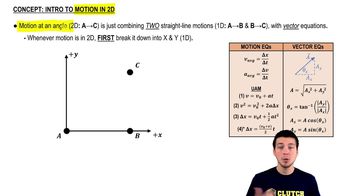
Intro to Motion in 2D: Position & Displacement definitions
You can tap to flip the card.
Two-dimensional motion
You can tap to flip the card.
👆
Two-dimensional motion
Movement in a plane involving both X and Y axes, often represented through vector equations.
Track progress
Control buttons has been changed to "navigation" mode.
1/15
Related flashcards
Related practice
Recommended videos
Intro to Motion in 2D: Position & Displacement quiz
Intro to Motion in 2D: Position & Displacement
13 Terms
Intro to Motion in 2D: Position & Displacement quiz #1
Intro to Motion in 2D: Position & Displacement
14 Terms
Intro to Motion in 2D: Position & Displacement
4. 2D Kinematics
5 problems
Topic
Patrick
Velocity in 2D
4. 2D Kinematics
5 problems
Topic
Catherine
4. 2D Kinematics - Part 1 of 2
5 topics
12 problems
Chapter
Patrick
4. 2D Kinematics - Part 2 of 2
2 topics
6 problems
Chapter
Guided course
07:07
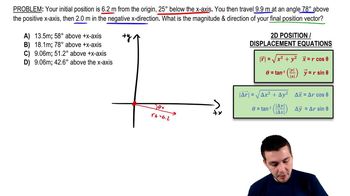
Final Position Vector
11122
views
249
rank
9
comments
Guided course
01:39
Intro to Motion in 2D
18118
views
340
rank
Guided course
06:30
Position and Displacement in 2D
14852
views
287
rank
Terms in this set (15)
Hide definitions
Two-dimensional motion
Movement in a plane involving both X and Y axes, often represented through vector equations.
Position vector
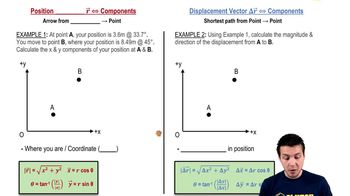
A vector pointing from the origin to a specific point, represented as r with components X and Y.
Displacement
The shortest path between two points, represented as a vector with X and Y components.
Vector
A quantity with both magnitude and direction, used to represent position and displacement.
Components
The X and Y parts of a vector, calculated using trigonometric functions like cosine and sine.
Magnitude
The length of a vector, calculated using the Pythagorean theorem for displacement.
Direction
The angle of a vector, determined using the tangent inverse of the Y component over the X component.
Pythagorean theorem
A formula to calculate the magnitude of a vector: square root of X squared plus Y squared.
Tangent inverse
A trigonometric function used to find the angle of a vector from its components.
Trigonometric functions
Functions like cosine and sine used to decompose vectors into X and Y components.
Coordinate
A pair of values (X, Y) representing a point's position in a two-dimensional plane.
Origin
The starting point (0,0) in a coordinate system from which vectors are measured.
Triangle
A geometric shape used to break down vectors into components in two-dimensional motion.
Delta
A symbol representing change, used in vectors to denote displacement.
Angle
The measure of rotation needed to align one vector with another, often found using trigonometry.
 BackBack

 07:07
07:07