Vectors, Scalars, & Displacement quiz #1 Flashcards

Vectors, Scalars, & Displacement quiz #1
Control buttons has been changed to "navigation" mode.
1/40
  • What is the x component of a vector?
    The x component of a vector is the part of the vector that points in the horizontal direction and represents how much of the vector lies along the x-axis.
  • What is displacement in physics?
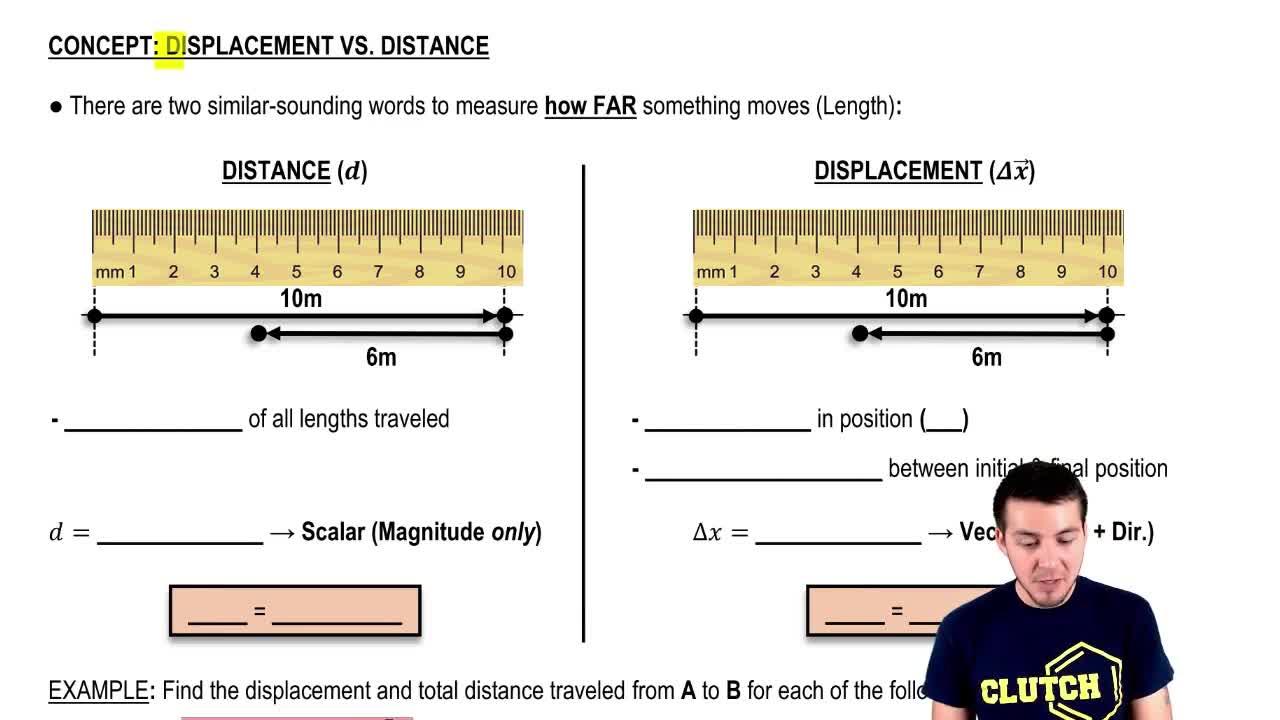
    Displacement is the change in position of an object, defined as the shortest path between the initial and final positions. It is a vector quantity, meaning it has both magnitude and direction.
  • Which of the following is a scalar quantity: mass, force, or velocity?
    Mass is a scalar quantity because it has magnitude only and no direction.
  • Which vector quantity describes the shortest path between two points?
    Displacement describes the shortest path between two points and is a vector quantity.
  • Can two vectors of unequal magnitude ever sum to zero?
    No, two vectors of unequal magnitude cannot sum to zero; only vectors of equal magnitude and opposite direction can sum to zero.
  • The magnitude of both scalar and vector quantities are represented by what aspect of a line?
    The magnitude is represented by the length of a line.
  • Which quantity is a vector quantity: velocity or temperature?
    Velocity is a vector quantity because it has both magnitude and direction.
  • What does a vector have that a scalar does not have?
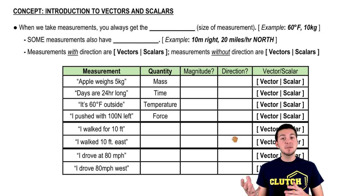
    A vector has direction in addition to magnitude, while a scalar has only magnitude.
  • What is true about two vectors that are equal in magnitude but opposite in direction?
    Two vectors that are equal in magnitude but opposite in direction will sum to zero when added together.
  • What is the result of two displacement vectors having opposite directions?
    If two displacement vectors have opposite directions, their sum will be the difference in their magnitudes and will point in the direction of the larger vector.
  • Which of the following are vector quantities: displacement, velocity, or distance?
    Displacement and velocity are vector quantities; distance is a scalar.
  • How do you find the magnitude of a vector with components (x, y)?
    The magnitude of a vector with components (x, y) is found using the formula: magnitude = sqrt(x^2 + y^2).
  • How do you calculate the magnitude of a vector given its components?
    The magnitude of a vector is calculated using the Pythagorean theorem: magnitude = sqrt(x^2 + y^2), where x and y are the vector's components.
  • How do you find the resultant vector when adding two vectors a and b?
    The resultant vector is found by adding the corresponding components of vectors a and b.
  • Why are forces considered to be vectors?
    Forces are considered vectors because they have both magnitude and direction.
  • Which physical quantities are vectors?
    Physical quantities such as displacement, velocity, and force are vectors because they have both magnitude and direction.
  • Is momentum a scalar or vector quantity?
    Momentum is a vector quantity because it has both magnitude and direction.
  • Which of the following would be considered a vector: speed or velocity?
    Velocity is considered a vector because it has both magnitude and direction.
  • What is a vector quantity?
    A vector quantity is a measurement that has both magnitude and direction.
  • Which of the following is a pair of vector quantities: displacement and velocity or mass and temperature?
    Displacement and velocity are a pair of vector quantities.
  • How do you find the magnitude of the vector c = a - b?
    The magnitude of c = a - b is found by subtracting the components of b from a and then using the formula: magnitude = sqrt((a_x - b_x)^2 + (a_y - b_y)^2).
  • Which of the following is an example of a vector quantity: force or temperature?
    Force is an example of a vector quantity.
  • Which of the following quantities are vectors: displacement, velocity, or speed?
    Displacement and velocity are vectors; speed is a scalar.
  • Which of the following are scalar quantities: mass, time, or velocity?
    Mass and time are scalar quantities; velocity is a vector.
  • How is a vector shown in component form?
    A vector in component form is written as (x, y), where x and y are its components along the x and y axes.
  • Which two components must a vector quantity have?
    A vector quantity must have both magnitude and direction.
  • What is the angle between the x and y components of a vector?
    The angle between the x and y components of a vector is 90 degrees.
  • Why are velocity and displacement both considered vector quantities?
    Velocity and displacement are considered vector quantities because they have both magnitude and direction.
  • If displacement has a magnitude and direction, is it a scalar or vector quantity?
    Displacement is a vector quantity because it has both magnitude and direction.
  • What is the x component vx of a velocity vector v?
    The x component vx of a velocity vector v is the part of the velocity that points along the x-axis.
  • Under what circumstances would a vector have components that are equal in magnitude?
    A vector will have components equal in magnitude if it points at a 45-degree angle to the axes in a coordinate system.
  • Is speed a scalar or vector quantity?
    Speed is a scalar quantity because it has magnitude only and no direction.
  • Which of the following is not a vector: displacement, velocity, or mass?
    Mass is not a vector; it is a scalar.
  • What is a difference between distance and displacement?
    Distance is the total length traveled and is a scalar, while displacement is the change in position and is a vector.
  • How are distance and displacement similar and different?
    Both distance and displacement measure how far an object moves, but distance is a scalar (total length traveled) and displacement is a vector (change in position with direction).
  • Which of these is not a vector quantity: force, velocity, or temperature?
    Temperature is not a vector quantity; it is a scalar.
  • Which quantity is a vector: velocity or mass?
    Velocity is a vector quantity.
  • Is distance a scalar or vector quantity?
    Distance is a scalar quantity because it has magnitude only and no direction.
  • Which is a vector quantity: displacement or speed?
    Displacement is a vector quantity.
  • Is velocity a scalar or vector quantity?
    Velocity is a vector quantity because it has both magnitude and direction.