Elastic Collisions quiz #1 Flashcards

Elastic Collisions quiz #1
Control buttons has been changed to "navigation" mode.
1/10
  • Why do elastic balls bounce so well?
    Elastic balls bounce well because, during an elastic collision, both momentum and kinetic energy are conserved. This means that when an elastic ball hits a surface, very little energy is lost to deformation, heat, or sound, allowing most of the ball's kinetic energy to be converted back into motion after the collision. As a result, the ball rebounds with nearly the same speed it had before impact, making it bounce efficiently.
  • What additional equation, besides conservation of momentum, is required to solve elastic collision problems?
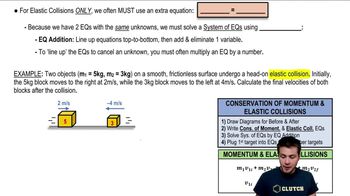
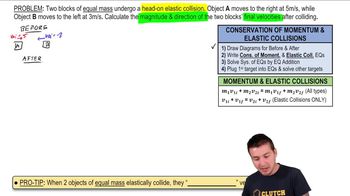
    The elastic collision equation is required in addition to conservation of momentum. This equation reflects the conservation of kinetic energy in elastic collisions.
  • How does the order of variables differ between the conservation of momentum equation and the elastic collision equation?
    The conservation of momentum equation uses the order 1-2-1-2 (initial, initial, final, final), while the elastic collision equation uses 1-1-2-2 (initial, final, initial, final). Remembering this helps avoid confusion when setting up equations.
  • What is the main advantage of using the special final velocity formulas when one object is stationary in an elastic collision?
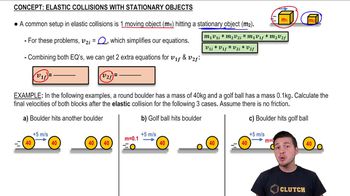
    The special formulas allow you to directly calculate the final velocities without solving a system of equations. This is possible because the initial velocity of the stationary object is zero, simplifying the math.
  • In an elastic collision between two objects of equal mass, what happens to their velocities after the collision?
    The two objects exchange velocities after the collision. The moving object's velocity becomes the stationary object's velocity, and vice versa.
  • What happens to the velocity of a much lighter object after it collides elastically with a much heavier stationary object?
    The lighter object reverses direction and moves back with nearly the same speed it had before the collision. The heavier object gains only a tiny amount of speed.
  • How do you solve for the second unknown velocity after finding one in a system of equations for elastic collisions?
    You substitute the known value into either of the original equations to solve for the remaining unknown. This process is standard when solving systems of two equations with two unknowns.
  • What is the final velocity of the stationary object in an elastic collision when the moving object is much more massive?
    The stationary object moves forward with a velocity nearly twice the initial velocity of the massive moving object. The massive object loses very little speed in the process.
  • Why is it important to correctly assign which object is m1 and which is m2 in the special elastic collision formulas?
    The moving object must always be assigned as m1 and the stationary object as m2 for the formulas to yield correct results. Incorrect assignment can lead to wrong answers for final velocities.
  • What general rule can you state about the direction of motion of the stationary object after an elastic collision?
    The stationary object always moves forward after the collision, regardless of the mass ratio. The direction of the moving object after the collision depends on the relative masses.