Electric Charge definitions Flashcards

Electric Charge definitions
3 students found this helpful
Control buttons has been changed to "navigation" mode.
1/15
  • Electric charge
    A fundamental property of matter that causes it to experience a force when placed in an electromagnetic field.
  • Proton
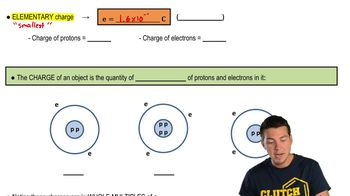
    A subatomic particle found in the nucleus of an atom, carrying a positive elementary charge.
  • Electron
    A subatomic particle with a negative elementary charge, orbiting the nucleus of an atom.
  • Neutron
    A subatomic particle found in the nucleus of an atom, having no electric charge.
  • Nucleus
    The central part of an atom, containing protons and neutrons, and holding most of the atom's mass.
  • Elementary charge
    The smallest unit of electric charge, quantified as 1.6 x 10^-19 Coulombs.
  • Coulomb
    The SI unit of electric charge, symbolized as C.
  • Net charge
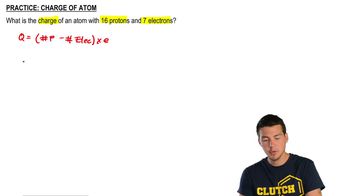
    The total electric charge of an object, determined by the imbalance of protons and electrons.
  • Charge quantization
    The principle that electric charge comes in integer multiples of the elementary charge.
  • Electric force
    The force exerted by charged objects on each other, proportional to the amount of charge.
  • Positive charge
    A type of electric charge carried by protons, resulting in repulsion or attraction with other charges.
  • Negative charge
    A type of electric charge carried by electrons, resulting in repulsion or attraction with other charges.
  • Electrically neutral
    A state where an object has equal numbers of protons and electrons, resulting in a net charge of zero.
  • Atomic structure
    The arrangement of protons, neutrons, and electrons within an atom.
  • Imbalance
    A condition where the number of protons and electrons in an object are not equal, leading to a net charge.