How do electric field lines visually indicate the strength of the electric field?
The strength of the electric field is indicated by the density of electric field lines; regions where the lines are closer together represent stronger electric fields, while regions where the lines are farther apart represent weaker fields.
Why can electric field lines never cross, and what would it mean if they did?
Electric field lines can never cross because at any point in space, the electric field has a unique direction. If field lines crossed, it would imply that the electric field has two different directions at the same point, which is physically impossible.
What are the key properties and rules of electric field lines?
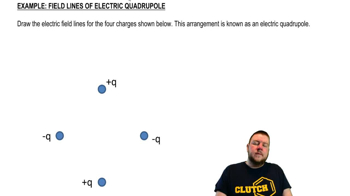
Electric field lines point from positive charges to negative charges, never cross each other, and their density indicates field strength. The direction of the field line shows the direction a positive test charge would move.
In a circuit diagram, what does a continuous line connecting components represent?
A continuous line in a circuit diagram represents a conducting path, typically a wire, that allows electric current to flow between components.
How does the direction of the force on a positive charge compare to the direction of the electric field at that point?
The force on a positive charge is in the same direction as the electric field at that point. This is because the product Q*E remains positive for positive Q.
What happens to the strength of the electric field as the distance from a point charge increases?
The strength of the electric field decreases rapidly with distance, following an inverse square law. Specifically, it is proportional to 1/R^2, where R is the distance from the charge.
When constructing electric field lines for a dipole, how do the lines behave near the midpoint between the charges?
Near the midpoint, the net electric field points horizontally from the positive to the negative charge. The vertical components of the fields from each charge cancel due to symmetry.
How do electric field lines behave off the midline in a dipole configuration?
Off the midline, electric field lines curve and are influenced by the vector sum of the fields from both charges. The lines show complex interactions and are not straight.
If an electron is placed directly between the charges of a dipole, in which direction will it accelerate?
The electron will accelerate opposite to the direction of the electric field, which is from the negative charge toward the positive charge. This is because electrons have negative charge.
Why do electric field lines form arcs between the charges in a dipole rather than straight lines?
The arcs result from the combined influence of both charges, with the field lines starting at the positive and ending at the negative charge. The curvature reflects the vector addition of the fields at each point.