Control buttons has been changed to "navigation" mode.
1/40
Terms in this set (40)
What formula gives the strength of the electric field produced by a point charge at a distance r?
The electric field strength E produced by a point charge Q at a distance r is given by E = kQ/r^2, where k is Coulomb's constant.
What is the strength of an electric field that will balance the weight of a proton?
The electric field strength E required to balance the weight of a proton is E = mg/q, where m is the mass of the proton, g is the acceleration due to gravity, and q is the charge of the proton.
How is the direction of an electric field defined?
The direction of the electric field is defined as the direction of the force that would be exerted on a positive test charge placed at that point.
What does the electric field strength tell about the electric field?
The electric field strength indicates the magnitude of the force per unit charge that a positive test charge would experience at a given point.
What is the magnitude of the electric field produced by a charge that creates a 1.0 N/C field at a point 1.0 m away?
Using E = kQ/r^2, set E = 1.0 N/C and r = 1.0 m, so Q = E r^2 / k.
Which describes the electric field produced by a positive charge?
A positive charge produces an electric field that points radially outward from the charge.
What is produced around a wire when an electrical current is in the wire?
An electric current in a wire produces a magnetic field around the wire.
What influences the strength of an electric field?
The strength of an electric field depends on the magnitude of the source charge and the distance from the charge, following E = kQ/r^2.
Can an object with no net charge have an electric field?
An object with no net charge does not produce a net electric field, but it may have local fields due to charge distributions within it.
What is the relationship between the charges and the field strength?
The electric field strength at a point is directly proportional to the magnitude of the source charge and inversely proportional to the square of the distance from the charge.
What is the function of the round third prong in a modern household electric plug?
The round third prong serves as a ground connection for safety, providing a path for electric current to the earth in case of a fault.
Which particle remains undeflected when passing through an electric field?
A neutral particle remains undeflected when passing through an electric field because it has no charge.
Which of the following statements are true for electric field lines?
Electric field lines point away from positive charges and toward negative charges, and their density represents the field strength.
What is the main purpose of mapping an electric field?
Mapping an electric field helps visualize the direction and strength of the field at various points in space.
What is the mathematical expression for the electric field at a point due to a point charge?
The electric field at a point due to a point charge is E = kQ/r^2, where Q is the charge and r is the distance from the charge to the point.
At which point is the electric field stronger: closer to or farther from the source charge?
The electric field is stronger closer to the source charge, as field strength decreases with the square of the distance.
What is the measure of a specific material’s ability to insulate charges from each other?
A material's ability to insulate charges is measured by its dielectric constant or permittivity.
What are the SI units of electric field strength?
The SI units of electric field strength are Newtons per Coulomb (N/C).
What is the electric field at a distance of r from a source charge Q?
The electric field at a distance r from a source charge Q is E = kQ/r^2.
A charge distribution has electric field lines pointing into it. What sign is the net charge?
If electric field lines point into a charge distribution, the net charge is negative.
In which case does an electric field do positive work on a charged particle?
An electric field does positive work on a charged particle when the particle moves in the direction of the electric field.
Which of these is described as force per unit charge on a positive test charge?
The electric field is defined as the force per unit charge on a positive test charge.
What is the electric field outside a conductor under electrostatic conditions?
The electric field just outside a charged conductor is perpendicular to the surface and proportional to the surface charge density.
What is the direction of the electric field at a point directly to the left of a positive charge?
The electric field at a point directly to the left of a positive charge points away from the charge, i.e., to the left.
Why are magnetic and electric fields considered force fields?
Magnetic and electric fields are considered force fields because they exert forces on charges and currents placed within them.
What is the strength of the electric field at a position (x, y) due to a point charge Q?
The electric field strength at position (x, y) due to a point charge Q is E = kQ/r^2, where r is the distance from Q to (x, y).
All electric currents generate what type of fields?
All electric currents generate magnetic fields.
What is the strength of the electric field at a position (x, y) = (0 cm, 5.0 cm) due to a point charge Q at the origin?
The electric field strength at (0 cm, 5.0 cm) is E = kQ/r^2, where r = 5.0 cm.
What is the radial component of the electric field outside a spherical shell of charge Q at distance r?
The radial component of the electric field outside a spherical shell is E(r) = kQ/r^2.
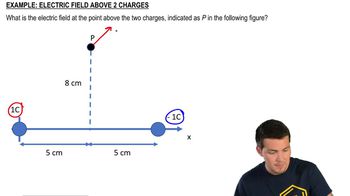
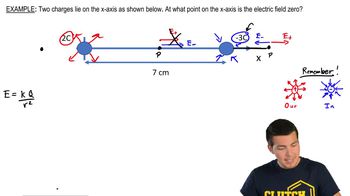
The electric field due to a combination of charges can be zero at what location?
The electric field can be zero at a point where the vector sum of the fields from all charges cancels out.
As a proton moves in a direction perpendicular to the electric field lines, what happens to its potential energy?
If a proton moves perpendicular to electric field lines, its electric potential energy does not change.
A point charge of magnitude q is at the center of a cube with sides of length l. What is the electric field at a point on the surface of the cube?
The electric field at a point on the surface of the cube is E = kq/r^2, where r is the distance from the charge to the point.
Find the x-component of the electric field at the origin due to a point charge Q at position (x0, y0).
The x-component is Ex = kQ x0 / (x0^2 + y0^2)^{3/2}.
As an electron moves in the direction of the electric field lines, what happens to its potential energy?
As an electron moves in the direction of the electric field lines, its electric potential energy increases.
Every charge has what type of field?
Every charge has an electric field.
As a proton moves in the direction of the electric field lines, what happens to its potential energy?
As a proton moves in the direction of the electric field lines, its electric potential energy decreases.
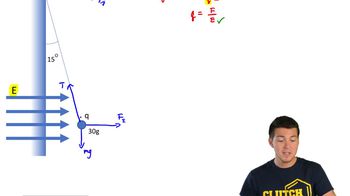
Consider a uniform electric field. What is the force on a charge q placed in this field?
The force is F = qE, where E is the uniform electric field.
At a point directly between two wires carrying equal but opposite currents, what is the direction of the net magnetic field?
The net magnetic field at a point directly between two wires with equal but opposite currents is the vector sum of the fields from each wire.
Under electrostatic conditions, what is the direction of the electric field just outside the surface of any charged conductor?
The electric field just outside the surface of a charged conductor is perpendicular to the surface.
What is the magnitude of the electric field due to a uniformly charged slab at a point within the slab (0 < |x| < d)?
The magnitude depends on the charge distribution; for a uniform slab, E is proportional to the distance from the center.