Pearson+ LogoPearson+ Logo

Electric Fields in Conductors quiz #1 Flashcards

Back
Electric Fields in Conductors quiz #1
Control buttons has been changed to "navigation" mode.
1/10
  • What causes the distribution of charge in conductors and insulators?

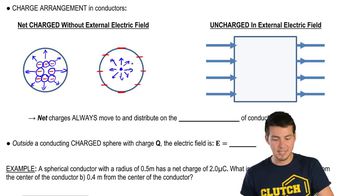
    In conductors, free electrons are able to move and redistribute themselves on the surface to maximize their distance from each other, canceling any internal electric field. This movement is driven by the repulsion between like charges. In insulators, electrons are not free to move, so charge remains localized and does not redistribute throughout the material.
  • What is the electric field inside a conductor, and why does it have this value?

    The electric field inside a conductor is always zero. This is because free electrons within the conductor rearrange themselves in response to any internal or external electric field, creating an internal field that cancels out the applied field, resulting in a net electric field of zero inside the conductor.
  • Why do excess electrons in a conductor move to the surface rather than staying inside?

    Excess electrons move to the surface to maximize their distance from each other due to mutual repulsion. This arrangement minimizes the potential energy and cancels the internal electric field.
  • What happens to the distribution of positive and negative charges in a neutral conductor placed in an external electric field?

    Positive charges shift in the direction of the field, while negative charges move opposite, causing polarization. This separation sets up an internal field that cancels the external field inside the conductor.
  • How does the electric field at the center of a charged spherical conductor compare to the field at its surface?

    The electric field at the center is zero, while at the surface it can be nonzero depending on the net charge. The field outside the surface follows the point charge formula.
  • What formula is used to calculate the electric field outside a charged spherical conductor?

    The formula is E = kQ/r^2, where k is Coulomb's constant, Q is the net charge, and r is the distance from the center. This treats the sphere as if all charge were concentrated at its center.
  • If you add more electrons to a conductor, how do they arrange themselves?

    They spread out on the surface to maximize their separation from each other. This distribution ensures the internal electric field remains zero.
  • What is the electric field at a point inside a conductor with a net charge?

    The electric field at any point inside the conductor is zero, regardless of the net charge. This is due to the redistribution of charges on the surface.
  • How does a conductor respond to an external electric field in terms of internal charge movement?

    Charges within the conductor rearrange, with positive charges moving with the field and negative charges against it. This movement creates an internal field that cancels the external field inside.
  • At a distance less than the radius from the center of a charged spherical conductor, what is the electric field?

    The electric field is zero at any point inside the conductor, including distances less than the radius. This holds true regardless of the amount of net charge on the conductor.