Electric Flux definitions Flashcards

Electric Flux definitions
Control buttons has been changed to "navigation" mode.
1/15
  • Electric Flux
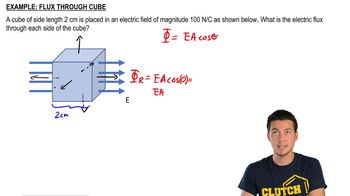
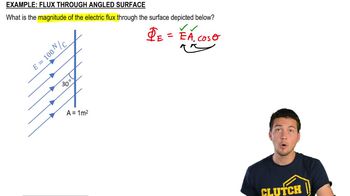
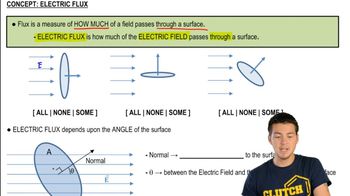
    A measure of the electric field passing through a surface, influenced by the field's angle to the surface's normal.
  • Electric Field
    A field around charged particles that exerts force on other charges, represented by field lines.
  • Surface
    A boundary through which electric field lines pass, affecting the calculation of electric flux.
  • Normal
    A vector perpendicular to a surface, used to determine the angle with electric field lines.
  • Angle
    The measure between the electric field lines and the normal, affecting the electric flux value.
  • Closed Surface
    A boundary enclosing a volume, like a box, used to calculate total electric flux.
  • Positive Flux
    Occurs when electric field lines and the normal point in the same direction, resulting in a positive value.
  • Negative Flux
    Occurs when electric field lines and the normal point in opposite directions, resulting in a negative value.
  • Total Flux
    The sum of electric fluxes through all surfaces of a closed boundary.
  • Area Vector
    A vector representing the magnitude and direction of a surface area, used in flux calculations.
  • Cosine
    A trigonometric function used to calculate the component of the electric field through a surface.
  • Gauss's Law
    A principle relating the electric flux through a closed surface to the charge enclosed.
  • Net Electric Flux
    The overall electric flux through a closed surface, accounting for positive and negative contributions.
  • Field Lines
    Imaginary lines representing the direction and strength of an electric field.
  • Perpendicular Vector
    A vector at a right angle to a surface, synonymous with the normal in flux calculations.