Electric Flux quiz #1 Flashcards

Electric Flux quiz #1
Control buttons has been changed to "navigation" mode.
1/10
  • How do you calculate the electric flux through an annular ring when an electric field passes through it at an angle?
    The electric flux through an annular ring is calculated using the formula Φ = E A cos(θ), where E is the electric field strength, A is the area of the ring, and θ is the angle between the electric field and the normal (perpendicular) to the surface.
  • How do you determine the net electric flux through a closed cylindrical surface in the presence of an electric field?
    The net electric flux through a closed cylindrical surface is the sum of the electric flux through each part of the cylinder, calculated as Φ_total = Σ (E_i A_i cos(θ_i)), where E_i is the electric field at each surface segment, A_i is the area, and θ_i is the angle between the electric field and the normal to each surface.
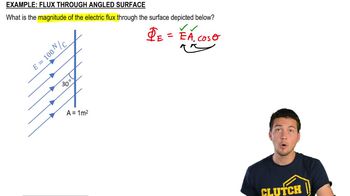
  • How is the electric flux through a given surface determined when an electric field passes through it?
    The electric flux through a surface is given by Φ = E A cos(θ), where E is the electric field magnitude, A is the area of the surface, and θ is the angle between the electric field and the normal to the surface.
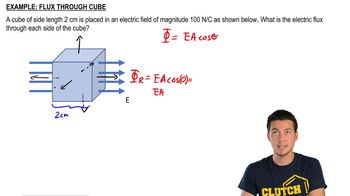
  • What is the electric flux through each of the six faces of a cube when an electric field is present?
    The electric flux through each face of a cube is calculated as Φ = E A cos(θ) for each face, where E is the electric field, A is the area of the face, and θ is the angle between the electric field and the normal to that face. The net flux through the cube is the sum of the fluxes through all six faces.
  • How do you calculate the electric flux through a closed surface that encloses multiple objects?
    The electric flux through a closed surface that encloses multiple objects is the sum of the electric flux through each part of the surface, calculated as Φ_total = Σ (E_i A_i cos(θ_i)), where E_i is the electric field at each surface segment, A_i is the area, and θ_i is the angle between the electric field and the normal to each segment.
  • How do you find the electric flux through a cylindrical surface due to an infinite line of charge?
    The electric flux through a cylindrical surface due to an infinite line of charge is calculated using Φ = E A cos(θ), where E is the electric field at the surface, A is the area of the cylindrical surface, and θ is the angle between the electric field and the normal to the surface. For a cylinder surrounding the line, θ is typically 0°, so cos(θ) = 1.
  • How do you determine the electric flux through each surface of a closed object when given the cross-sectional areas and the electric field?
    The electric flux through each surface is calculated as Φ = E A cos(θ), where E is the electric field at the surface, A is the area of the surface, and θ is the angle between the electric field and the normal to the surface. The net flux is the sum of the fluxes through all surfaces.
  • How do you calculate the electric flux through a loop placed in an electric field?
    The electric flux through a loop is given by Φ = E A cos(θ), where E is the electric field strength, A is the area of the loop, and θ is the angle between the electric field and the normal to the loop's surface.
  • How is the electric flux through a shaded surface determined when an electric field passes through it?
    The electric flux through a shaded surface is calculated using Φ = E A cos(θ), where E is the electric field magnitude, A is the area of the shaded surface, and θ is the angle between the electric field and the normal to the surface.
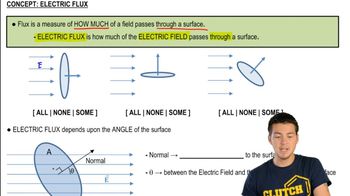
  • What determines whether the electric flux through a surface is positive, negative, or zero?
    The sign of the electric flux depends on the direction of the electric field relative to the normal of the surface: it is positive if they point in the same direction, negative if opposite, and zero if the field is parallel to the surface. This is because the cosine of the angle between the field and the normal determines the sign and magnitude of the flux.