What is the work done by the electric force to move a 1 C charge from point A to point B in terms of electric potential difference?
The work done by the electric force to move a 1 C charge from point A to point B is equal to the change in electric potential energy, which is numerically equal to the electric potential difference (ΔV) between A and B multiplied by the charge: W = qΔV. For a 1 C charge, W = ΔV.
When a positive charge moves against the direction of the electric field, does its electric potential energy increase or decrease?
When a positive charge moves against the direction of the electric field, its electric potential energy increases.
If two positive charges are equal, which configuration has more electric potential energy: when they are close together or far apart?
Two equal positive charges have more electric potential energy when they are close together, because electric potential energy between two like charges increases as the distance between them decreases.
What potential difference is required to bring a proton to rest if it is moving with a certain initial kinetic energy?
The potential difference required to bring a proton to rest is equal to the initial kinetic energy of the proton divided by its charge: ΔV = KE_initial / e, where e is the elementary charge.
For an electric dipole in a uniform electric field, what orientation corresponds to the greatest electric potential energy?
The greatest electric potential energy for a dipole in a uniform electric field occurs when the dipole is oriented anti-parallel to the field (i.e., the dipole moment points opposite to the electric field direction).
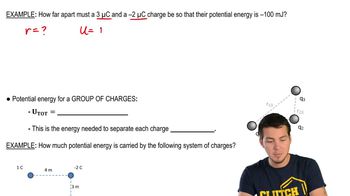
How do you calculate the total electric potential energy of a group of point charges?
The total electric potential energy of a group of point charges is the sum of the potential energies of all unique pairs of charges, calculated using U_total = Σ (K * Qi * Qj / rij), where K is Coulomb's constant, Qi and Qj are the charges, and rij is the distance between each pair.
How does the formula for electric potential energy between two point charges differ from Coulomb's law in terms of distance dependence?
The electric potential energy formula uses 1/r, while Coulomb's law uses 1/r^2 for the distance dependence. This means potential energy decreases more slowly with distance than force does.
When calculating the total electric potential energy of a system of three point charges, what must you consider about the distances between charges?
You must use the actual distances between each unique pair of charges, including diagonal distances found using the Pythagorean theorem if necessary. Each pair's potential energy is calculated separately and then summed.
Why is it important to include the signs of the charges when calculating electric potential energy?
The signs determine whether the potential energy is positive or negative, affecting the physical interpretation of the system. Unlike force calculations, you cannot ignore the sign when finding potential energy.
What does the total electric potential energy of a group of charges represent in terms of moving the charges to infinity?
It represents the energy required to separate all the charges infinitely far apart, or equivalently, the energy needed to assemble the system from charges initially at infinity. This is a common way to interpret the total potential energy in a system.