Skip to main content
Physics with Calculus
My Course
Learn
Exam Prep
AI Tutor
Study Guides
Textbook Solutions
Flashcards
Explore
Try the app
My Course
Learn
Exam Prep
AI Tutor
Study Guides
Textbook Solutions
Flashcards
Explore
Try the app
Back
Energy in Pendulums definitions
1 student found this helpful
You can tap to flip the card.
Pendulum
You can tap to flip the card.
👆
Pendulum
A weight suspended from a pivot so it can swing freely, exhibiting periodic motion.
Track progress
Control buttons has been changed to "navigation" mode.
1/15
Related flashcards
Related practice
Recommended videos
Energy in Pendulums quiz
Energy in Pendulums
10 Terms
Energy in Pendulums quiz #1
Energy in Pendulums
10 Terms
Energy in Pendulums
17. Periodic Motion
4 problems
Topic
Patrick
Simple Harmonic Motion of Pendulums
17. Periodic Motion
7 problems
Topic
Patrick
17. Periodic Motion - Part 1 of 2
4 topics
10 problems
Chapter
Patrick
17. Periodic Motion - Part 2 of 2
3 topics
9 problems
Chapter
David-Paige
Guided course
06:53
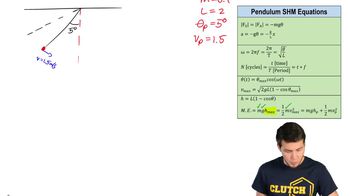
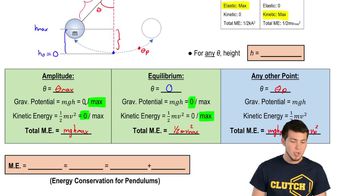
Energy in Pendulums
7541
views
73
rank
1
comments
Guided course
04:56
Example
5623
views
55
rank
3
comments
Terms in this set (15)
Hide definitions
Pendulum
A weight suspended from a pivot so it can swing freely, exhibiting periodic motion.
Kinetic Energy
Energy possessed by an object due to its motion, maximized at the pendulum's lowest point.
Gravitational Potential Energy
Energy stored due to an object's height, maximized at the pendulum's highest points.
Equilibrium Position
The lowest point in a pendulum's swing where kinetic energy is maximized.
Theta
The angle between the pendulum and the vertical, affecting height and energy.
Length (L)
The distance from the pivot to the pendulum's mass, crucial for calculating height and speed.
Zero Point
The reference level for potential energy, set at the pendulum's lowest swing point.
Maximum Height (Hmax)
The highest vertical position of the pendulum, where potential energy is maximized.
Maximum Velocity (Vmax)
The highest speed reached by the pendulum, calculated using energy conservation.
Energy Conservation
The principle stating total mechanical energy remains constant in a pendulum's motion.
Pendulum Equation
Formula h = L - L cos(theta) used to calculate height at any swing point.
Amplitude
The maximum angular displacement from the vertical, indicating the swing's extent.
Mechanical Energy
The sum of kinetic and potential energy in a pendulum, conserved throughout its motion.
Sohcahtoa
A mnemonic for trigonometric ratios, used to derive pendulum height from angle.
Vertical Height
The distance from the zero point to the pendulum's current position, affecting potential energy.
 BackBack

 06:53
06:53