Skip to main content
Physics with Calculus
My Course
Learn
Exam Prep
AI Tutor
Study Guides
Textbook Solutions
Flashcards
Explore
Try the app
My Course
Learn
Exam Prep
AI Tutor
Study Guides
Textbook Solutions
Flashcards
Explore
Try the app
Back
Energy in Simple Harmonic Motion definitions
You can tap to flip the card.
Simple Harmonic Motion
You can tap to flip the card.
👆
Simple Harmonic Motion
A type of periodic motion where the restoring force is directly proportional to the displacement.
Track progress
Control buttons has been changed to "navigation" mode.
1/15
Related flashcards
Related practice
Recommended videos
Energy in Simple Harmonic Motion quiz #1
Energy in Simple Harmonic Motion
10 Terms
Energy in Simple Harmonic Motion
17. Periodic Motion
9 problems
Topic
Patrick
Simple Harmonic Motion of Vertical Springs
17. Periodic Motion
7 problems
Topic
Patrick
17. Periodic Motion - Part 1 of 2
4 topics
10 problems
Chapter
Patrick
17. Periodic Motion - Part 2 of 2
3 topics
9 problems
Chapter
David-Paige
Guided course
03:56
Example
6547
views
126
rank
3
comments
Guided course
07:02
Energy in Simple Harmonic Motion
11342
views
146
rank
3
comments
Guided course
06:46
Example
7809
views
115
rank
2
comments
Terms in this set (15)
Hide definitions
Simple Harmonic Motion
A type of periodic motion where the restoring force is directly proportional to the displacement.
Kinetic Energy
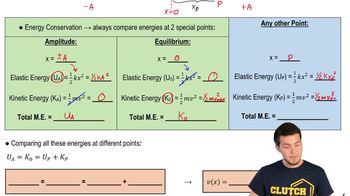
Energy associated with the motion of an object, calculated as 1/2 mv^2.
Elastic Potential Energy
Energy stored in a spring when it is compressed or stretched, given by 1/2 kx^2.
Amplitude
The maximum displacement from the equilibrium position in harmonic motion.
Equilibrium Point
The position where the net force on the mass is zero, and kinetic energy is maximized.
Mechanical Energy
The sum of kinetic and potential energy in a system, conserved in the absence of non-conservative forces.
Spring Constant
A measure of a spring's stiffness, denoted by k, in Hooke's law.
Velocity-Position Relationship
An equation relating velocity to position in harmonic motion: v = sqrt((k/m) * (a^2 - x^2)).
Maximum Speed
The highest velocity reached by an object in harmonic motion, occurring at the equilibrium point.
Conservation of Energy
A principle stating that total mechanical energy remains constant in an isolated system.
Displacement
The distance and direction from the equilibrium position in harmonic motion.
Non-Conservative Forces
Forces like friction that cause energy to be lost from a system, not present in ideal harmonic motion.
Restoring Force
The force that brings a system back to equilibrium, proportional to displacement in springs.
Hooke's Law
The principle stating that the force exerted by a spring is proportional to its displacement.
Total Mechanical Energy
The constant energy in a system, sum of kinetic and potential energies, in harmonic motion.
 BackBack

 03:56
03:56