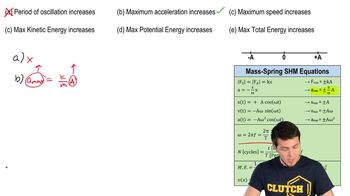
How does the total mechanical energy of a mass-spring system in simple harmonic motion change if the amplitude of oscillation is doubled?
The total mechanical energy of a mass-spring system in simple harmonic motion is given by E = (1/2)kA^2, where k is the spring constant and A is the amplitude. If the amplitude doubles, the energy becomes E' = (1/2)k(2A)^2 = 2^2 × (1/2)kA^2 = 4E. Therefore, the total mechanical energy increases by a factor of four when the amplitude is doubled.
What type of energy is maximized when a mass-spring system is at its maximum displacement from equilibrium?
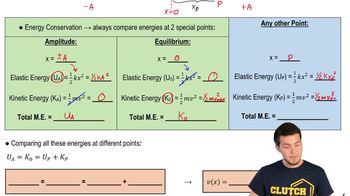
The elastic potential energy is maximized at maximum displacement. At this point, the kinetic energy is zero.
At what position in a mass-spring system is the kinetic energy maximized during simple harmonic motion?
The kinetic energy is maximized at the equilibrium position, where displacement x equals zero. At this point, the velocity is at its maximum.
How does the velocity of a mass in a spring system depend on its position according to the derived formula?
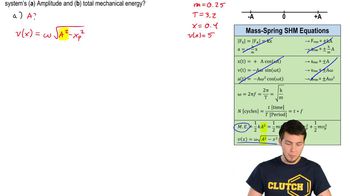
The velocity at position x is given by v = sqrt((k/m) * (a^2 - x^2)). This shows that velocity decreases as the displacement from equilibrium increases.
What is the total mechanical energy of a mass-spring system in the absence of friction?
The total mechanical energy remains constant and is the sum of kinetic and elastic potential energies. It can be calculated using E = (1/2)kA^2 or E = (1/2)mv_max^2.
What happens to the kinetic and potential energies at any point other than the amplitude or equilibrium in a mass-spring system?
Both kinetic and elastic potential energies are nonzero at positions other than amplitude or equilibrium. Their sum always equals the total mechanical energy.
Which equation relates the kinetic and potential energies at any position in a mass-spring system?
The equation is (1/2)kA^2 = (1/2)kx^2 + (1/2)mv^2. This expresses conservation of mechanical energy for the system.
How can you calculate the maximum speed of a mass attached to a spring using the spring constant and amplitude?
Maximum speed is found using v_max = sqrt(k/m) * A. This uses the relationship between energy and motion in the system.
If you know the mass, spring constant, and amplitude, which forms of the energy conservation equation can you use to find total mechanical energy?
You can use either E = (1/2)kA^2 or E = (1/2)mv_max^2. Both yield the same value for total mechanical energy.
What is the velocity of a mass in a spring system at a specific position x, and how is it calculated?
The velocity at position x is v = sqrt((k/m) * (A^2 - x^2)). This formula comes from the conservation of energy in the system.