Energy with Non-Conservative Forces definitions Flashcards
Energy with Non-Conservative Forces definitions
You can tap to flip the card.
Control buttons has been changed to "navigation" mode.
1/15
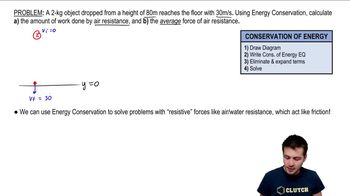
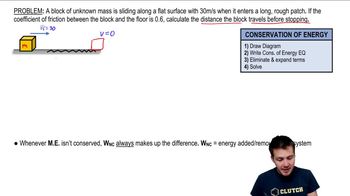
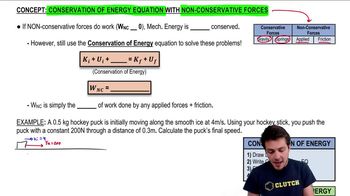
Conservation of EnergyA principle stating that the total energy in an isolated system remains constant, accounting for both conservative and non-conservative forces.Non-Conservative ForcesForces like friction and applied forces that cause energy to be added or removed from a system, affecting mechanical energy conservation.Applied ForceAn external force exerted on an object, often resulting in work done and changes in the object's energy.FrictionA force opposing motion between surfaces in contact, often converting kinetic energy into thermal energy.Kinetic EnergyThe energy an object possesses due to its motion, calculated as 1/2 times mass times velocity squared.Potential EnergyEnergy stored in an object due to its position or configuration, often associated with gravitational or elastic forces.WorkThe process of energy transfer to or from an object via a force acting over a distance, calculated as force times distance times cosine of the angle.Mechanical EnergyThe sum of kinetic and potential energy in a system, which may change due to non-conservative forces.Smooth IceA surface with negligible friction, allowing for minimal energy loss due to frictional forces.Cosine ThetaA trigonometric function used in calculating work, representing the angle between force direction and displacement.Initial SpeedThe speed of an object before any external forces are applied, used as a reference in energy calculations.Final SpeedThe speed of an object after external forces have acted on it, often determined using energy equations.JoulesThe SI unit of energy or work, equivalent to one newton meter.MassA measure of the amount of matter in an object, influencing its resistance to acceleration.DistanceThe length of the path over which a force is applied, affecting the work done on an object.