When a car skids to a halt due to friction, what happens to its kinetic energy?
The car's kinetic energy is transformed into other forms, primarily thermal energy (heat) due to friction between the tires and the road, and possibly some sound energy.
What is true about the work done by a non-conservative force such as friction or an applied force?
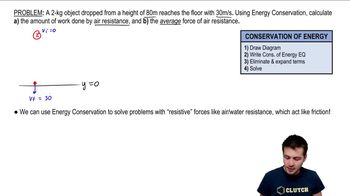
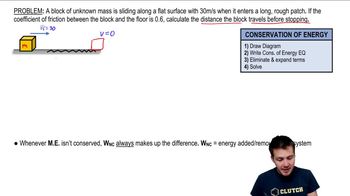
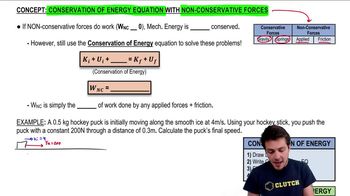
The work done by a non-conservative force adds or removes energy from the system, causing the mechanical energy (kinetic plus potential) to not be conserved. This work must be included in the full conservation of energy equation.
Does a sled lose mechanical energy as it moves down a hill if friction is present?
Yes, if friction is present, the sled loses mechanical energy because friction is a non-conservative force that transforms some of the sled's mechanical energy into thermal energy.
Why doesn't a ball bounce back to its original height after being dropped?
A ball does not bounce back to its original height because non-conservative forces like air resistance and deformation (which produce heat and sound) cause some of its mechanical energy to be lost to other forms, such as thermal and sound energy.
What happens to the energy when a moving car comes to a stop?
When a moving car comes to a stop, its kinetic energy is converted into other forms, mainly thermal energy due to friction (in the brakes and tires), and possibly sound energy.
Can a car coast to the top of a hill without additional energy input, and what factors affect this?
A car can only coast to the top of a hill if its initial mechanical energy (kinetic plus potential) is sufficient to overcome the increase in potential energy and any energy lost to non-conservative forces like friction. If non-conservative forces are significant, additional energy input may be required.
What is the angle used in the work calculation when the applied force and displacement are in the same direction?
The angle is 0 degrees because both the applied force and displacement point in the same direction. This makes the cosine of the angle equal to 1.
How do you calculate the work done by an applied force in the context of the hockey puck example?
The work is calculated using the formula W = F × d × cos(θ), where F is the applied force, d is the distance, and θ is the angle between force and displacement. In the example, θ is 0 degrees, so cos(θ) is 1.
Why is the mechanical energy not conserved in the hockey puck example?
Mechanical energy is not conserved because a non-conservative force (the applied force from the hockey stick) does work on the puck. This work adds energy to the system, increasing the puck's kinetic energy.
What is the final speed of the hockey puck after being pushed, according to the example calculation?
The final speed of the hockey puck is 16 meters per second. This result is obtained by applying the full conservation of energy equation with the work done by the applied force.