What does the second law of thermodynamics state about entropy?
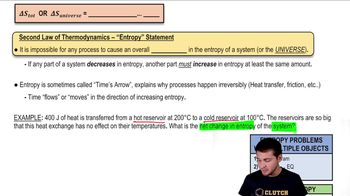
The second law of thermodynamics states that the total entropy of a system or the universe can never decrease; it can only increase or remain constant.
What is true about entropy in relation to heat transfer?
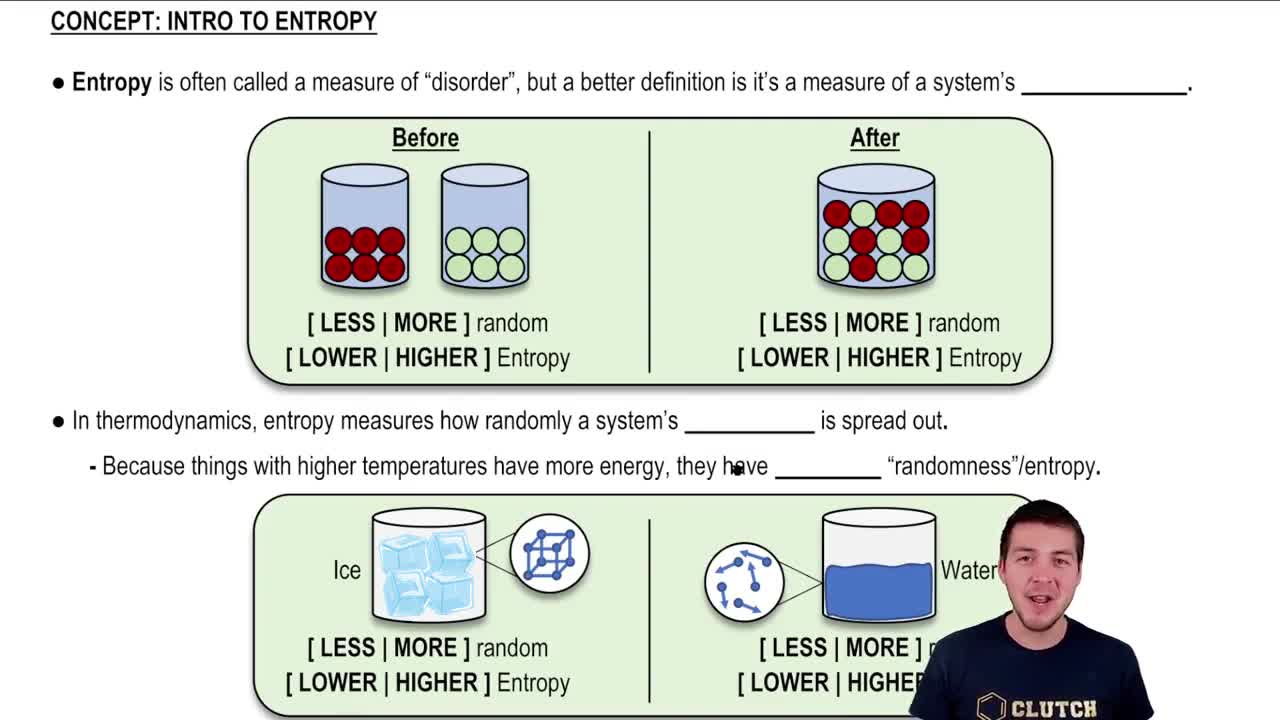
Entropy is a measure of the randomness or disorder within a system, and it increases when heat is added to a system and decreases when heat is removed.
Which process produces a decrease in the entropy of the system?
A process that removes heat from a system, such as freezing water to ice, produces a decrease in the entropy of the system.
What process produces a decrease in the entropy of the system involving heat removal?
A process that involves the removal of heat, such as the condensation of steam into water, results in a decrease in the entropy of the system.
What is a more precise definition of entropy in thermodynamics?
Entropy is a measure of a system's randomness or how spread out its energy is at the atomic level.
How is the change in entropy (
abla S) calculated in isothermal processes?
The change in entropy is calculated using the equation
abla S = Q/T, where Q is the heat transferred and T is the temperature in Kelvin.
What happens to entropy when heat is added to or removed from a system?
Adding heat to a system increases its entropy, while removing heat decreases its entropy.
How does the second law of thermodynamics relate to entropy?
The second law of thermodynamics states that the total entropy of a system or the universe can never decrease; it can only increase or remain constant.
What is the significance of entropy being described as 'time's arrow'?
Entropy as 'time's arrow' indicates the irreversible nature of processes that increase entropy, such as heat transfer and friction.
What is the relationship between temperature and entropy in a system?
In general, systems with higher temperatures have more energy, which can be spread around more, leading to higher randomness and therefore higher entropy.