Rotational Velocity & Acceleration quiz #1 Flashcards

Rotational Velocity & Acceleration quiz #1
Control buttons has been changed to "navigation" mode.
1/10
  • What are the common units used to express rotational (angular) velocity in physics?
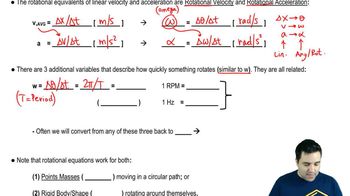
    Rotational (angular) velocity is commonly expressed in units of radians per second (rad/s), revolutions per minute (RPM), and hertz (Hz, or revolutions per second).
  • List the units that can be used to express angular velocity, often denoted by the symbol omega (Ω).
    Angular velocity (Ω) can be expressed in radians per second (rad/s), revolutions per minute (RPM), and hertz (Hz, or revolutions per second).
  • What is the formula for average angular velocity in terms of angular displacement and time?
    Average angular velocity is given by omega equals delta theta divided by delta t. Delta theta is the change in angle in radians, and delta t is the change in time.
  • How do you convert a rotational speed given in RPM to frequency in hertz?
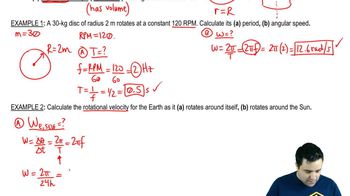
    To convert RPM to frequency in hertz, divide the RPM value by 60. This gives the number of revolutions per second.
  • What is the relationship between period (T) and frequency (f) in rotational motion?
    Period and frequency are inverses of each other, so T equals 1 divided by f. This means if you know one, you can calculate the other.
  • Which Greek letters are commonly used to represent angular position, angular velocity, and angular acceleration?
    Theta is used for angular position, omega for angular velocity, and alpha for angular acceleration. These are the rotational analogs of x, v, and a in linear motion.
  • What distinguishes a point mass from a rigid body in rotational motion problems?
    A point mass is an object with negligible size and zero radius, while a rigid body has a definite radius and volume. The equations for rotational motion apply to both, but the physical interpretation differs.
  • If an object completes one full revolution, what is the angular displacement in radians?
    One full revolution corresponds to an angular displacement of 2 pi radians. This is because a circle has 2 pi radians in total.
  • How can you calculate angular velocity if you know the period of rotation?
    Angular velocity omega can be calculated as 2 pi divided by the period T. This gives the result in radians per second.
  • What is the unit of angular acceleration and how is it defined?
    Angular acceleration is measured in radians per second squared. It is defined as the change in angular velocity divided by the change in time.