Equilibrium in 2D - Ladder Problems definitions Flashcards
Equilibrium in 2D - Ladder Problems definitions
You can tap to flip the card.
Control buttons has been changed to "navigation" mode.
1/15
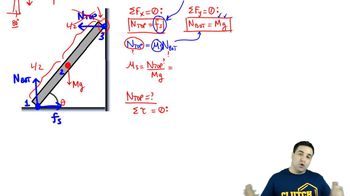
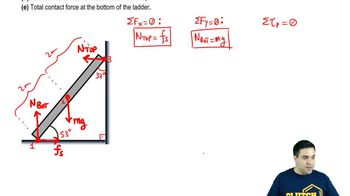
EquilibriumA state where all forces and torques are balanced, resulting in no net motion.TorqueA measure of the rotational force applied at a distance from an axis of rotation.Normal ForceA perpendicular force exerted by a surface to support the weight of an object resting on it.Static FrictionThe force that prevents an object from moving when in contact with a surface.Coefficient of Static FrictionA dimensionless value representing the ratio of the maximum static frictional force to the normal force.Vector AdditionThe process of combining two or more vectors to determine a resultant vector.Pythagorean TheoremA mathematical principle used to calculate the magnitude of a resultant vector in a right triangle.ArctangentA trigonometric function used to determine the angle whose tangent is a given number.Axis of RotationA line about which an object rotates or is symmetrically arranged.Gravitational ForceThe force of attraction between an object and the Earth, proportional to the object's mass.Contact ForceThe force exerted by objects in direct contact, including normal and frictional forces.ScalarA quantity with magnitude but no direction, such as torque in this context.Angle of InclinationThe angle formed between a reference line, such as the horizontal, and an inclined surface.Uniform DistributionA condition where mass is evenly spread across an object's length or volume.VectorA quantity with both magnitude and direction, used to represent forces and velocities.