Equilibrium in 2D - Ladder Problems quiz #1 Flashcards

Equilibrium in 2D - Ladder Problems quiz #1
Control buttons has been changed to "navigation" mode.
1/10
  • How do you determine the minimum angle that a ladder can make with the floor without slipping, in terms of the coefficient of static friction between the ladder and the floor?
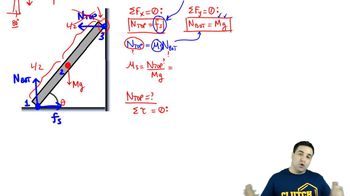
    To find the minimum angle θ_min at which a ladder can rest against a wall without slipping, set up the equilibrium conditions for forces and torques. The key is that the static friction force at the base must be sufficient to prevent slipping. The minimum angle occurs when the static friction force reaches its maximum value, which is μ_s times the normal force at the base (F_friction = μ_s N_bottom). By analyzing the torque and force balance equations, you can derive a relationship between θ_min and the coefficient of static friction μ_s. The general approach is: 1. Write the force equilibrium equations in both x and y directions. 2. Write the torque equilibrium equation about the base of the ladder. 3. Set the friction force equal to its maximum value (F_friction = μ_s N_bottom). 4. Solve for θ_min in terms of μ_s. The resulting equation will allow you to calculate the minimum angle for any given coefficient of static friction.
  • Why is the gravitational force considered to act at the midpoint of a uniformly distributed ladder?
    For a uniformly distributed ladder, the center of mass is at its midpoint, so gravity acts there. This simplifies calculations for torque and equilibrium.
  • What is the direction of the normal force at the top of the ladder when it rests against a vertical wall?
    The normal force at the top of the ladder is perpendicular to the wall, pointing horizontally away from the wall. This force prevents the ladder from moving into the wall.
  • Why do we choose the bottom of the ladder as the axis of rotation when writing the torque equation to solve for the normal force at the top?
    Choosing the bottom as the axis eliminates the torques from forces acting at that point, reducing the number of terms in the equation. This makes it easier to solve for the unknown normal force at the top.
  • How do you determine the angle to use in the torque calculation for the gravitational force acting on the ladder?
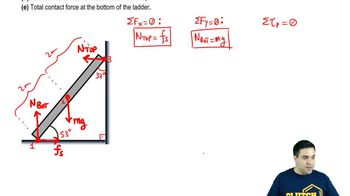
    The angle used is between the ladder and the horizontal, subtracted from 90 degrees, giving the angle between the force and the lever arm. For a 53-degree ladder, this angle is 37 degrees.
  • What is the relationship between the static friction force at the bottom and the normal force at the top of the ladder in equilibrium?
    In equilibrium, the static friction force at the bottom equals the normal force at the top. This is because they are the only horizontal forces acting and must balance each other.
  • How is the magnitude of the total contact force at the bottom of the ladder calculated?
    The total contact force is found by vector addition of the normal force and the static friction force at the bottom. The Pythagorean theorem is used since the forces are perpendicular.
  • What mathematical function is used to find the direction of the total contact force at the bottom of the ladder?
    The arctangent function is used, taking the ratio of the normal force to the static friction force. This gives the angle of the total force relative to the horizontal.
  • Why do torques not need to be decomposed into components when solving ladder equilibrium problems?
    Torques are scalar quantities, so their direction is given by sign (positive or negative) rather than vector components. This means you only need to consider their magnitude and sense of rotation.
  • What is the significance of the coefficient of static friction being less than one in the context of ladder problems?
    A coefficient of static friction less than one indicates that the frictional force is less than the normal force. This is typical for most surfaces and ensures the ladder can remain in equilibrium without slipping.