Escape Velocity definitions Flashcards
Escape Velocity definitions
You can tap to flip the card.
Control buttons has been changed to "navigation" mode.
1/15
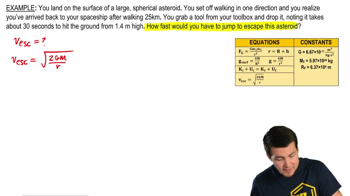
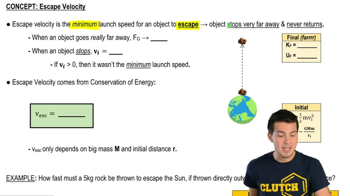
Escape VelocityMinimum speed needed for an object to break free from a celestial body's gravitational pull without returning.Gravitational ForceAttractive force between two masses, decreasing with increased distance.Kinetic EnergyEnergy possessed by an object due to its motion, calculated as 1/2 m v^2.Gravitational Potential EnergyEnergy due to an object's position in a gravitational field, approaching zero as distance increases.Conservation of EnergyPrinciple stating total energy in a closed system remains constant, used to derive escape velocity.Gravitational ConstantUniversal constant (G) used in the calculation of gravitational forces and escape velocity.MassQuantity of matter in a body, affecting gravitational force but not escape velocity.DistanceInitial separation from a celestial body's center, influencing the required escape velocity.VelocitySpeed of an object in a specific direction, crucial for determining escape velocity.Final VelocitySpeed of an object when it reaches an infinitely distant point, ideally zero for escape velocity.Celestial BodyNatural object in space, such as a planet or star, from which escape velocity is calculated.Orbital DistanceAverage distance from a planet to the sun, used in escape velocity calculations.Square RootMathematical operation used in the escape velocity formula to solve for speed.Non-conservative ForcesForces like friction that do work on a system, not present in escape velocity calculations.Launch SpeedInitial speed required to achieve escape velocity, ensuring the object does not return.