Escape Velocity quiz #1 Flashcards

Escape Velocity quiz #1
Control buttons has been changed to "navigation" mode.
1/10
  • What is escape velocity, and what is the general formula for calculating the escape velocity from a celestial body such as Earth?
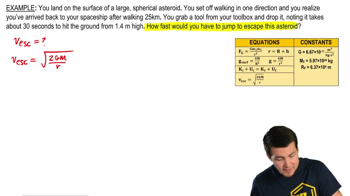
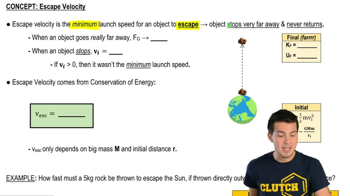
    Escape velocity is the minimum speed an object must have to escape the gravitational pull of a celestial body, such as Earth, so that it never returns. The general formula for escape velocity is v = sqrt(2GM/r), where G is the gravitational constant, M is the mass of the celestial body, and r is the initial distance from the center of that body.
  • Why can't kinematic equations be used to calculate escape velocity from Earth?
    Kinematic equations assume constant acceleration, but gravitational acceleration decreases with distance from Earth. Therefore, conservation of energy must be used instead.
  • What happens to the gravitational force acting on an object as it moves infinitely far from Earth?
    The gravitational force approaches zero as the distance between the object and Earth becomes infinitely large. This is because the force is inversely proportional to the square of the distance.
  • Why must the final velocity of an object at infinity be zero for it to have achieved escape velocity?
    If the final velocity at infinity were greater than zero, the object was launched faster than necessary. Escape velocity is defined as the minimum speed needed so that the final velocity at infinity is exactly zero.
  • What is the initial kinetic energy expression used when deriving the escape velocity formula?
    The initial kinetic energy is given by (1/2)mv^2, where m is the mass of the object and v is its initial speed. This energy is part of the total mechanical energy considered in the derivation.
  • How does the gravitational potential energy change as an object moves farther from the center of a celestial body?
    The gravitational potential energy increases toward zero as the distance increases. At infinite distance, the potential energy is defined as zero.
  • In the escape velocity formula, which variables does the escape velocity depend on?
    Escape velocity depends only on the mass of the celestial body being escaped from and the initial distance from its center. It does not depend on the mass of the escaping object.
  • When calculating the escape velocity from the sun at Earth's orbital distance, what value is used for the distance variable?
    The average distance between the Earth and the sun is used for the distance variable. This is because the sun's radius is negligible compared to this distance.
  • What is the approximate escape velocity required for an object to leave the sun's gravity from Earth's orbital distance?
    The escape velocity is about 42.1 kilometers per second from Earth's orbital distance. This value is calculated using the escape velocity formula with the sun's mass and the Earth-sun distance.
  • Why does the mass of the object not affect the escape velocity required to leave a celestial body?
    The object's mass cancels out during the derivation of the escape velocity formula. Therefore, escape velocity is independent of the object's mass.