Banked Curves definitions Flashcards

Banked Curves definitions
Control buttons has been changed to "navigation" mode.
1/15
  • Banked Curve
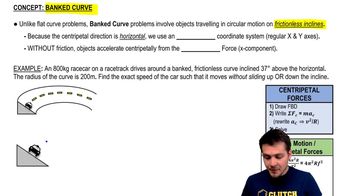
    An inclined path designed to help vehicles turn in a circle without relying on friction.
  • Normal Force
    The force perpendicular to the surface of the incline, providing centripetal force in banked curves.
  • Centripetal Force
    The force required to keep an object moving in a circular path, provided by the horizontal component of the normal force in banked curves.
  • Incline Angle
    The angle of the banked curve, crucial for determining the optimal velocity to prevent sliding.
  • Centripetal Acceleration
    The acceleration directed towards the center of the circular path, calculated as v^2/r.
  • Free Body Diagram
    A visual representation of forces acting on an object, used to analyze motion on banked curves.
  • Gravitational Force
    The force acting downwards on the car, equal to the car's mass times gravity.
  • Horizontal Component
    The part of the normal force that provides the necessary centripetal force for circular motion.
  • Vertical Component
    The part of the normal force that balances the gravitational force, preventing vertical acceleration.
  • Optimal Velocity
    The specific speed required to maintain a car's path on a banked curve without sliding.
  • Radius of Curve
    The distance from the center of the circular path to the curve, affecting the required centripetal force.
  • Static Friction
    The force that prevents sliding on flat curves, absent in banked curve problems.
  • Coordinate System
    The reference frame used to analyze forces, not tilted in banked curve problems.
  • Tangent Function
    A trigonometric function used to relate the incline angle to the normal force components.
  • Mass Cancellation
    The process where mass terms cancel out in equations, simplifying the calculation of velocity.