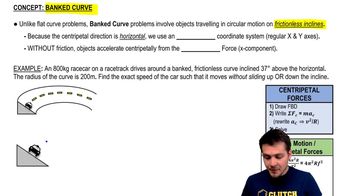
Banked Curves quiz #1 Flashcards

Banked Curves quiz #1
Control buttons has been changed to "navigation" mode.
1/10
  • What is the formula for the ideal speed to take a banked curve of radius r that is inclined at an angle θ, and how would you use it to find the ideal speed for a curve with a 100 m radius banked at a 20.0° angle?
    The ideal speed v for a frictionless banked curve is given by v = sqrt(g * r * tan(θ)), where g is the acceleration due to gravity, r is the radius of the curve, and θ is the banking angle. For a curve with a 100 m radius banked at 20.0°, substitute r = 100 m and θ = 20.0° into the formula to calculate the ideal speed.
  • Why are roads sometimes banked on curves, and what effect does banking have on the forces acting on a vehicle traveling around the curve?
    Roads are banked on curves to allow vehicles to safely travel around the curve without relying on friction. Banking provides a component of the normal force that acts horizontally, supplying the necessary centripetal force for circular motion. This helps prevent vehicles from sliding up or down the incline and allows them to maintain their path at a specific speed determined by the banking angle and curve radius.
  • Why is the coordinate system not tilted when analyzing banked curve problems?
    The coordinate system is not tilted because the centripetal acceleration is purely horizontal, aligning with the standard x and y axes. This differs from typical inclined plane problems where the acceleration is along the incline.
  • What happens if a car travels slower than the ideal speed on a frictionless banked curve?
    If a car travels slower than the ideal speed, it will slide down the incline due to insufficient centripetal force. This is because the normal force's horizontal component cannot fully provide the needed centripetal acceleration.
  • Which force provides the centripetal acceleration on a frictionless banked curve?
    The horizontal component of the normal force provides the centripetal acceleration on a frictionless banked curve. Friction does not contribute in this scenario.
  • How is the normal force decomposed in banked curve problems?
    The normal force is decomposed into a horizontal component (N sin θ) and a vertical component (N cos θ). The horizontal component supplies the centripetal force, while the vertical component balances the car's weight.
  • What is the relationship between the normal force and the car's weight in the vertical direction on a banked curve?
    In the vertical direction, the normal force's vertical component (N cos θ) equals the car's weight (mg). This ensures there is no vertical acceleration.
  • Why do the masses cancel out when deriving the ideal speed formula for a banked curve?
    The masses cancel out because both sides of the equation for centripetal force and weight contain the mass term. This results in a formula for speed that is independent of the car's mass.
  • What would happen if a car exceeds the ideal speed on a frictionless banked curve?
    If a car exceeds the ideal speed, it will slide up the incline and may eventually leave the ramp. This occurs because the horizontal component of the normal force becomes insufficient to keep the car on the path.
  • How does the formula for velocity on a flat curve differ from that on a banked curve?
    The flat curve velocity formula includes the coefficient of static friction (μ), while the banked curve formula uses the tangent of the banking angle (tan θ). This reflects the different forces responsible for centripetal acceleration in each case.