Skip to main content
Physics with Calculus
My Course
Learn
Exam Prep
AI Tutor
Study Guides
Textbook Solutions
Flashcards
Explore
Try the app
My Course
Learn
Exam Prep
AI Tutor
Study Guides
Textbook Solutions
Flashcards
Explore
Try the app
Back
Density quiz
You can tap to flip the card.
What is density and how is it calculated?
You can tap to flip the card.
👆
What is density and how is it calculated?
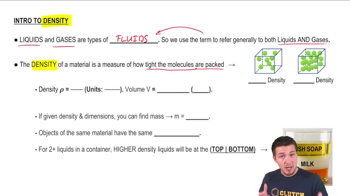
Density is the mass of an object divided by its volume, typically expressed in kg/m^3. It measures how tightly molecules are packed in a given volume.
Track progress
Control buttons has been changed to "navigation" mode.
1/10
Related flashcards
Related practice
Recommended videos
Density definitions
Density
15 Terms
Density quiz #1
Density
25 Terms
Density
19. Fluid Mechanics
6 problems
Topic
Patrick
Intro to Pressure
19. Fluid Mechanics
7 problems
Topic
Patrick
19. Fluid Mechanics - Part 1 of 2
3 topics
8 problems
Chapter
Patrick
19. Fluid Mechanics - Part 2 of 2
6 topics
13 problems
Chapter
Jonathan
Guided course
8:42
Density Values & Conversions
5813
views
109
rank
Guided course
8:13
Intro to Density
9785
views
245
rank
4
comments
Guided course
4:58
Specific Gravity
6650
views
90
rank
1
comments
Terms in this set (10)
Hide definitions
What is density and how is it calculated?
Density is the mass of an object divided by its volume, typically expressed in kg/m^3. It measures how tightly molecules are packed in a given volume.
What are three examples of a medium in the context of density?
Three examples of a medium in the context of density are water, air, and oil.
How does the density of a liquid affect its position in a container?
Higher density liquids will settle at the bottom of a container, while lower density liquids will float above them.
How can mass be calculated if density and volume are known?
Mass can be calculated by multiplying the density by the volume (mass = density × volume).
What is specific gravity and how is it related to density?
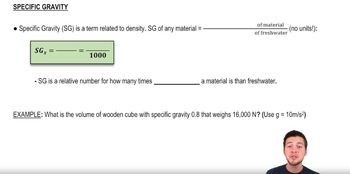
Specific gravity is the ratio of the density of a material to the density of freshwater. It indicates how much denser a material is compared to water.
In terms of complexity, how does specific gravity differ from density?
Specific gravity is a dimensionless number that compares the density of a material to water, while density is a measure of mass per unit volume.
Which is the largest unit of density commonly used in physics?
The largest unit of density commonly used in physics is kilograms per cubic meter (kg/m^3).
How can volume be calculated using specific gravity and weight?
Volume can be calculated by dividing the weight by the product of specific gravity and gravitational acceleration (V = W / (SG × g)).
Which is larger: the density of water or the density of air?
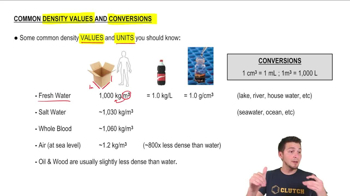
The density of water is larger than the density of air. Water has a density of approximately 1000 kg/m^3, while air has a density of about 1.2 kg/m^3.
What is the relationship between density and the ability of an object to float?
An object will float if its density is less than the density of the fluid it is placed in. If its density is greater, it will sink.
 BackBack

 8:42
8:42