Control buttons has been changed to "navigation" mode.
1/10
Terms in this set (10)
How is the right-hand rule used to determine the direction of the magnetic force on a positive charge moving in a magnetic field when the current (or velocity) is to the right?
To use the right-hand rule for a positive charge moving to the right in a magnetic field, point your right hand's fingers in the direction of the magnetic field (B), your thumb in the direction of the velocity (to the right), and your palm will face in the direction of the magnetic force. The palm indicates the direction of the force experienced by the charge.
In which direction does the magnetic force act on an electron moving in a magnetic field, and how do you determine this direction?
The direction of the magnetic force on an electron (a negative charge) moving in a magnetic field is found using the left-hand rule: point your left hand's fingers in the direction of the magnetic field, your thumb in the direction of the electron's velocity, and your palm will point in the direction of the force. The force direction is opposite to that for a positive charge moving in the same direction.
What is the correct description of the right-hand palm rule as used to determine the direction of the magnetic force on a moving positive charge?
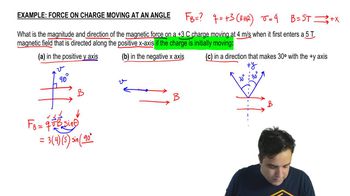
The right-hand palm rule involves pointing the fingers of your right hand in the direction of the magnetic field (B), your thumb in the direction of the velocity (V) of the positive charge, and your palm then points in the direction of the magnetic force exerted on the charge.
What is the equation for the magnitude of the magnetic force on a moving charge in a magnetic field?
The equation is F = QVBsin(θ), where Q is the charge, V is the velocity, B is the magnetic field strength, and θ is the angle between V and B. This equation gives the magnitude of the force experienced by the charge.
How do you represent the direction 'into the page' and 'out of the page' using symbols in physics diagrams?
An 'X' is used to represent a direction into the page, while a dot (•) is used to represent a direction out of the page. These symbols mimic the appearance of an arrow's tail and tip, respectively.
What happens to the magnetic force on a charge if its velocity is parallel to the magnetic field direction?
If the velocity is parallel to the magnetic field, the angle θ is 0 degrees and sin(0) is 0, so the magnetic force is zero. This means the charge experiences no magnetic force in this configuration.
When using the right hand rule, which part of your hand represents the direction of the magnetic field?
The four fingers of your right hand represent the direction of the magnetic field (B). You should keep your fingers together and point them in the direction of B.
What adjustment must you make to the right hand rule when determining the force direction on a negative charge?
For a negative charge, you use the left hand instead of the right hand to apply the rule. The rest of the procedure remains the same, with fingers for B, thumb for V, and palm for force.
Why is it important to be consistent with the version of the right hand rule you use?
Consistency ensures that your answers match those of your instructor or textbook, as different versions may use different conventions. Using the same method throughout avoids confusion and errors in direction.
What is the significance of the angle θ in the magnetic force equation F = QVBsin(θ)?
The angle θ is the angle between the velocity vector and the magnetic field vector. The sine of this angle determines how much of the velocity is perpendicular to the magnetic field, affecting the magnitude of the force.