Force & Potential Energy definitions Flashcards

Force & Potential Energy definitions
Control buttons has been changed to "navigation" mode.
1/15
  • Potential Energy Graph
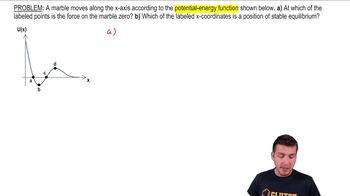
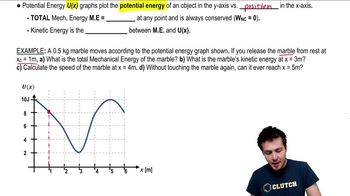
    A plot of potential energy versus position, used to analyze motion without complex equations.
  • Total Mechanical Energy
    The sum of kinetic and potential energy, conserved when non-conservative work is zero.
  • Kinetic Energy
    Energy of motion, calculated by subtracting potential energy from total mechanical energy.
  • Potential Energy Well
    A region in a potential energy graph where an object oscillates between turning points.
  • Turning Points
    Positions on a potential energy graph where an object's speed is zero and it changes direction.
  • Slope
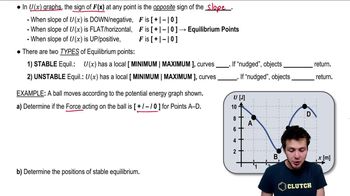
    Indicates the sign of the force on a potential energy graph; negative slope implies positive force.
  • Equilibrium Points
    Positions on a potential energy graph where the force is zero, can be stable or unstable.
  • Stable Equilibrium
    Occurs at a minimum potential energy point, where displacement leads to a return to equilibrium.
  • Unstable Equilibrium
    Occurs at a maximum potential energy point, where displacement leads to moving away from equilibrium.
  • Non-Conservative Forces
    Forces that do work on a system, changing its total mechanical energy.
  • Mechanical Energy Conservation
    Principle stating total mechanical energy remains constant if only conservative forces act.
  • Roller Coaster Analogy
    A way to visualize potential energy graphs as tracks, with energy changes like a roller coaster.
  • Horizontal Line
    Represents constant total mechanical energy on a potential energy graph.
  • Force Sign
    Determined by the opposite sign of the slope on a potential energy graph.
  • Curving Up/Down
    Describes the shape of potential energy graphs at equilibrium points, indicating stability.