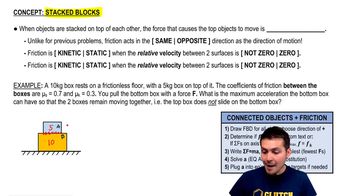
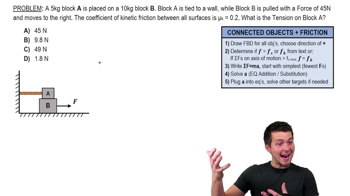
What is true about the physics of stacking structures, such as stacked blocks, in terms of friction and motion?
When objects are stacked, the friction between their surfaces determines whether they move together or slide relative to each other. If the applied acceleration to the bottom block does not exceed the maximum static friction force, the blocks move together. If the acceleration exceeds this limit, the top block will slide, and friction transitions from static to kinetic.
How can you determine the maximum acceleration at which materials (such as stacked blocks) can be safely moved together without causing the top block to slide off?
The maximum safe acceleration is given by a_max = μ_static × g, where μ_static is the coefficient of static friction between the stacked materials and g is the acceleration due to gravity. If the applied acceleration exceeds this value, the top block will begin to slide relative to the bottom block.
Why does the friction force on the top block act in the same direction as the system's motion in stacked block problems?
The friction force acts in the same direction as the system's motion because it is responsible for accelerating the top block along with the bottom block. This ensures both blocks move together without relative motion between them.
What determines whether the friction between two stacked blocks is static or kinetic?
The type of friction depends on the relative velocity between the two surfaces. If there is no relative motion, friction is static; if the blocks slide relative to each other, friction becomes kinetic.
In the free body diagram for the top block, what forces act vertically on the block?
The vertical forces are the weight of the block acting downward and the normal force from the bottom block acting upward. These forces balance each other since the block does not accelerate vertically.
What is the role of the normal force between the two blocks in calculating the maximum static friction?
The normal force between the blocks determines the maximum static friction because static friction is calculated as the coefficient of static friction times this normal force. It represents the contact force pressing the two surfaces together.
How does the action-reaction pair manifest in the friction forces between the two stacked blocks?
The friction force that accelerates the top block to the right has an equal and opposite friction force acting to the left on the bottom block. This is due to Newton's third law, which states that forces between two objects are equal in magnitude and opposite in direction.
Why can the mass of the top block be canceled out when solving for the maximum acceleration in this problem?
The mass appears on both sides of the equation for maximum static friction and acceleration, allowing it to be canceled algebraically. This means the maximum acceleration depends only on the coefficient of static friction and gravity, not the mass of the top block.
What happens to the type of friction if the applied acceleration exceeds the maximum value calculated?
If the applied acceleration exceeds the maximum, the blocks begin to slide relative to each other. At this point, the friction transitions from static to kinetic friction.
Why is it unnecessary to analyze the forces on the bottom block to find the maximum acceleration in this scenario?
The limiting factor for maximum acceleration is the static friction between the blocks, which is determined entirely by the forces on the top block. Therefore, analyzing the bottom block is not required to solve for the maximum acceleration.