What does a falling barometric reading (atmospheric pressure) indicate about the surrounding atmospheric conditions?
A falling barometric reading indicates that atmospheric pressure is decreasing, which often suggests that weather conditions are changing, such as the approach of a storm or a low-pressure system.
How does a barometer measure atmospheric pressure?
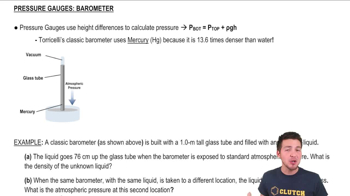
A barometer measures atmospheric pressure by using the height of a liquid column in a tube. Atmospheric pressure pushes on the liquid, forcing it up the tube, and the height of the column (h) is related to the pressure by the equation P_air = ρgh, where ρ is the liquid's density and g is gravitational acceleration.
Who invented the mercury barometer and what is its primary use?
The mercury barometer was invented by Torricelli, and it is primarily used to measure atmospheric pressure.
In a barometer, what does the pressure gauge at the top of the liquid column read?
At the top of the liquid column in a barometer, the pressure gauge reads zero, as this region is a vacuum.
Why must a water barometer be 13.6 times taller than a mercury barometer to measure the same atmospheric pressure?
A water barometer must be 13.6 times taller than a mercury barometer because mercury is 13.6 times denser than water. For the same atmospheric pressure, a less dense liquid like water requires a greater height to balance the pressure, as described by the equation P_air = ρgh.
What happens to the height of the liquid column in a barometer if the atmospheric pressure increases?
The height of the liquid column increases as atmospheric pressure increases. This is because greater pressure pushes more liquid up the tube.
Why is a vacuum necessary at the top of the barometer tube?
A vacuum at the top ensures there is no pressure opposing the atmospheric pressure pushing the liquid up. This allows the height of the column to directly reflect atmospheric pressure.
How can you determine the density of an unknown liquid in a barometer if you know the atmospheric pressure and column height?
You can rearrange the barometer equation to solve for density: ρ = P_air / (g * h). By plugging in the known values for atmospheric pressure, gravitational acceleration, and column height, you can calculate the liquid's density.
What would happen to the barometer reading if you took it from sea level to a high mountain?
The height of the liquid column would decrease at higher altitudes. This is because atmospheric pressure is lower on a mountain than at sea level.
Why is mercury preferred over water in barometer construction despite both being liquids?
Mercury is much denser than water, so the required column height for measuring atmospheric pressure is much shorter. This makes the barometer more compact and practical for use.
 Back
Back

 09:27
09:27