Skip to main content
Physics with Calculus
My Course
Learn
Exam Prep
AI Tutor
Study Guides
Textbook Solutions
Flashcards
Explore
Try the app
My Course
Learn
Exam Prep
AI Tutor
Study Guides
Textbook Solutions
Flashcards
Explore
Try the app
Back
Pressure Gauge: Manometer definitions
You can tap to flip the card.
Manometer
You can tap to flip the card.
👆
Manometer
A U-shaped tube used to measure pressure differences by comparing liquid column heights.
Track progress
Control buttons has been changed to "navigation" mode.
1/15
Related flashcards
Related practice
Recommended videos
Pressure Gauge: Manometer quiz #1
Pressure Gauge: Manometer
10 Terms
Pressure Gauge: Manometer
19. Fluid Mechanics
5 problems
Topic
Pressure Gauge: U-shaped Tube
19. Fluid Mechanics
5 problems
Topic
19. Fluid Mechanics - Part 1 of 2
3 topics
8 problems
Chapter
Patrick
19. Fluid Mechanics - Part 2 of 2
6 topics
13 problems
Chapter
Jonathan
Guided course
10:40
Pressure Gauges: Manometer
4670
views
35
rank
2
comments
Terms in this set (15)
Hide definitions
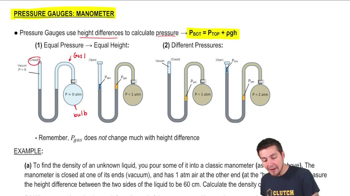
Manometer
A U-shaped tube used to measure pressure differences by comparing liquid column heights.
Pressure Gauge
An instrument used to measure the pressure of gases or liquids.
Vacuum
A space devoid of matter, resulting in zero pressure.
Atmosphere
A unit of pressure defined as 101,325 Pascals, equivalent to the pressure exerted by Earth's atmosphere at sea level.
Density
The mass per unit volume of a substance, often measured in kilograms per cubic meter.
Height Difference
The vertical distance between liquid levels in a manometer, used to calculate pressure differences.
Pascal
The SI unit of pressure, equivalent to one newton per square meter.
Gas Column
A vertical section of gas in a manometer, assumed to have uniform pressure throughout.
Pressure Ratio
The proportional relationship between pressure changes and height changes in a manometer.
Liquid Column
The vertical section of liquid in a manometer, where pressure varies with depth.
P Bottom
The pressure at the bottom of a liquid column in a manometer.
P Top
The pressure at the top of a liquid column in a manometer.
Rho
The symbol for density in the equation p_bottom = p_top + rho*g*h.
G
The acceleration due to gravity, approximately 9.8 m/s², used in pressure calculations.
Bulb
The part of a manometer containing gas, affecting the pressure on one side of the liquid column.
 BackBack

 10:40
10:40