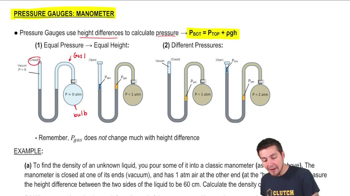
How do you calculate the gauge pressure at a specific point in a manometer using the height difference of the liquid column?
The gauge pressure at a point in a manometer is calculated using the equation p_gauge = ρgh, where ρ is the density of the manometer liquid, g is the acceleration due to gravity, and h is the height difference between the two sides of the liquid column.
What does the top pressure gauge of a manometer read when both sides are exposed to the same pressure?
When both sides of a manometer are exposed to the same pressure, the top pressure gauge reads zero gauge pressure, as there is no height difference in the liquid column.
Which scenario results in the highest pressure being applied in a manometer setup?
The scenario with the greatest pressure applied is when the height difference (h) of the manometer liquid is the largest, since pressure is directly proportional to the height difference (p = ρgh).
What is the term for the difference between the pressures inside and outside a tire?
The difference between the pressures inside and outside a tire is called the gauge pressure.
What term describes the maximum possible reading of a pressure gauge?
The maximum possible reading of a pressure gauge is called the full-scale or maximum gauge pressure.
What happens to the liquid levels in a manometer when both sides are exposed to a vacuum?
The liquid levels remain equal on both sides because there is no pressure difference to create a height difference. This is due to both sides having zero pressure.
Why can we assume uniform pressure throughout the gas column in a manometer?
We can assume uniform pressure because the pressure in gases does not change significantly with height differences in the manometer. This contrasts with liquids, where pressure varies more noticeably with depth.
In a manometer, which points are used to measure the height difference (h) for pressure calculations?
The height difference is measured between the interfaces where the liquid meets the gas on each side of the U-tube. This is the vertical distance directly across from one interface to the other.
What must you do before plugging atmospheric pressure values into the manometer equation?
You must convert atmospheric pressure from atmospheres to pascals before using it in the equation. This ensures all units are consistent in SI for calculations.
How does changing the gas pressure on one side of a manometer affect the height difference of the liquid column?
Increasing the gas pressure on one side increases the height difference proportionally. The ratio of the new pressure to the original pressure equals the ratio of the new height difference to the original height difference.