Gauss' Law quiz #1 Flashcards

Gauss' Law quiz #1
Control buttons has been changed to "navigation" mode.
1/10
  • According to Gauss's Law, through which type of closed Gaussian surface is the total electric flux zero?
    The total electric flux through a closed Gaussian surface is zero if the net charge enclosed within the surface is zero. This occurs when there are no charges inside the surface or when the sum of all enclosed charges is zero (for example, equal amounts of positive and negative charges inside the surface).
  • What does Gauss's Law state about the relationship between electric flux and enclosed charge?
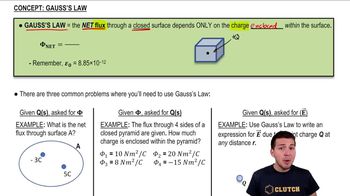
    Gauss's Law states that the total electric flux through a closed surface is equal to the net charge enclosed within that surface divided by the electric constant (ε₀), expressed as Φ_net = Q_enclosed / ε₀.
  • How do you determine the net electric flux through a closed Gaussian surface if you know the electric flux through each of its individual sides?
    To determine the net electric flux through a closed Gaussian surface, sum the electric flux values through all of its individual sides. The total (net) flux is the algebraic sum of the fluxes through each surface.
  • What is the significance of the surface being 'closed' in Gauss's Law?
    A closed surface is required in Gauss's Law because only then can you relate the net electric flux to the total charge enclosed. Open surfaces do not enclose a volume and thus cannot be used to apply Gauss's Law directly.
  • Why is it often impossible to use the E·A·cos(θ) formula directly for complex surfaces?
    The E·A·cos(θ) formula is difficult to use directly because both the electric field magnitude and the angle θ can vary at different points on the surface. This makes the calculation tedious or impossible without symmetry.
  • What is a Gaussian surface and why is it useful in applying Gauss's Law?
    A Gaussian surface is an imaginary closed surface chosen to exploit symmetry and simplify calculations using Gauss's Law. It allows you to relate the net flux to the enclosed charge without knowing the detailed field at every point.
  • Which three shapes are commonly chosen as Gaussian surfaces and why?
    Boxes, cylinders, and spheres are commonly chosen as Gaussian surfaces because they often match the symmetry of the charge distribution. This symmetry ensures the electric field is constant or easily described on the surface.
  • How does the choice of a spherical Gaussian surface simplify the calculation of the electric field from a point charge?
    A spherical Gaussian surface ensures the electric field is constant in magnitude and direction at every point on the surface. This makes the flux calculation straightforward, as the angle between the field and area vector is always zero.
  • What is the value and significance of the constant ε₀ (epsilon naught) in Gauss's Law?
    The constant ε₀, or epsilon naught, is approximately 8.85 × 10⁻¹² and is the electric constant that relates electric flux to enclosed charge. It appears in the denominator of Gauss's Law and sets the scale for electric interactions in vacuum.
  • How does Gauss's Law confirm the familiar formula for the electric field of a point charge?
    By applying Gauss's Law to a spherical surface around a point charge, you derive E = kQ/R², matching the known formula. This shows that Gauss's Law is consistent with Coulomb's Law for point charges.